| The communities living in the Himalayas have various ethnic affinities and display a variety of social systems, religions and customs. Over the centuries, the Himalayan people have witnessed invasions, migrations, political unrest and several wars. The culture of the people of this region has been shaped as a result of all these external and internal dynamics and the intermingling of various tribes, often of different religious affiliations. The topographical and ecological factors of the area have also played an important role in shaping the culture because of the heavy dependence of people on natural resources for their livelihood and sustenance. Thus, the culture has evolved into an interesting amalgam of various social customs and traditions and is manifested in the rich variety of languages, clothes, festivals and rituals followed. |
| In recent times, the traditional lifestyle is slowly changing traditional family structures and customs like polygamy are fast fading; systems of subsistence farming are giving way to cultivation of cash crops to meet the demand of increasing population as well as increased food demand from the plains The main causes for this societal change are an increased exposure to external influences through better road networks and communication facilities, integration of local markets with the regional economy and to some extent, the degradation of natural resources. |
- Development of infrastructure: Extension of road networks to remote areas, increased mobile coverage, wider spread of education facilities and better television facilities are changing the cultural patterns within Himalayan communities. In the northeastern state of Sikkim, the road network spans 3727 km in 2003 (national highways, state highways, district roads and border roads), an increase from 1516 km in 1993. Hitherto remote and inaccessible regions are now attracting people from various places, resulting in an intermingling of cultures at an unprecedented level. Exposure to external influences is subtly changing the social structure with erosion of local customs and food habits, fascination with foreign customs and decrease in use of traditional costumes. Youngsters are now slowly letting go of traditional practices like polygamy, and the mandatory systems of one family member joining the monastery is fading. In addition traditional occupations like agriculture are not much favoured. Another issue affecting the culture of the area is of urban migration. Better job opportunities and a different lifestyle are attracting the youth to cities, often causing breakdown of the traditional family structure. With the youth and men migrating to urban centres, women and elderly people find themselves burdened with managing their households and coping with the socioeconomic consequences of urban migration. However, increased mobility and access to information is helping all sections of the society (farmers are availing government schemes, drop-out rates are decreasing, the per capita income is increasing etc.).
- Education: Increased numbers of schools in villages and opening of institutions of higher education has resulted in higher literacy rates (71.62% in Uttrakhand in 2001 as against the national average of 61%), better employment prospects and often a change in outlook. In the state of Himachal Pradesh, up to 536 government schools have introduced IT facilities for better learning and is enhancing the quality of education given in the region. Education is breeding aspirations and often youth find themselves wanting to migrate to cities and towns in search of jobs.
- Tourism: With the rapid spread of tourism as a major source of income, several traditional economic activities like agriculture are being replaced with occupations like tour operators, restaurant owners, porters and trekking guides. In Sikkim alone, there is an increase in tourist influx by 25% per annum, which shows the growth of the sector in the area. In Nepal, the development of the tourism sector is serving as a blessing for the economy with most income generation occurring at the local level. On the other hand, an increased influx of tourists (domestic and foreign) is bringing in new ideas and exposing the local communities to different lifestyles, often at the cost of traditional customs. Also, with the betterment of village economies, some level of economic inequality has crept into communities.
|
| Thus, it is imperative to understand that in today’s day and age mountain communities are undergoing cultural changes and are slowly being re-oriented towards the outer world. The Himalayan culture, comprising of dynamic and vibrant communities, is changing. This change, like all changes, has both negative and positive aspects. Hopefully, a healthy balance will be struck between traditional customs and modern influences, so the new develops, but not at the cost of the old. |
|
|
|
| |
 | | Window to the world outside | 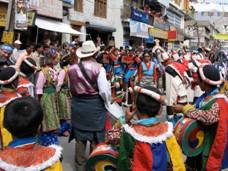 | | Ladakh Festival - tradition redefined | 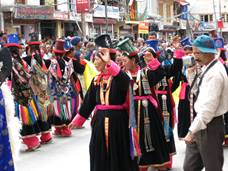 | | | | | | |
|


