| Profile: |
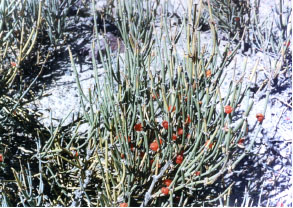
Ephedra gerardiana is a slow growing, rigid, tufted herb, 30-60 cm tall with numerous densely clustered, erect, slender, fluted, green, jointed branches arising from a branched, woody base in whorls. The plant has several medicinal uses as members of this genus contain medicinally active alkaloids, notably ephedrine, which is widely used in the treatment of asthma and catarrh. Main extracts obtained from the plant are alkaloids, ephedrine and pseudo-ephedrine. This herb should be used with great caution, preferably under the supervision of a qualified practitioner. It should not be prescribed to patients who are taking monoamine oxidase inhibitors or suffering from high blood pressure, hyperthyroidism or glaucoma. The plant is seen as a performance-boosting herb due to its ephedrine content and is a forbidden substance in many sporting events.
|
| Habitat and ecology: It is a perennial shrub found scattered at an altitude ranging from 3,000-5,500 m in dry, rocky zones and open slopes of alpine and temperate Himalayas. The plants can withstand temperatures as low as -15°C. Shrubs are distributed in the drier regions of temperate and alpine Himalayas from Kashmir to Sikkim, commonly in Pangi (Chamba), Lahaul and Spiti, Chini, Kilba-Kailash ranges of Kinnaur and Shali hills in Himachal Pradesh and in Ladakh and Kashmir regions of Jammu and Kashmir. |
| Morphology: It is a very slow growing, tufted, rigid, bushy shrub of variable size, with numerous, densely clustered, erect, smooth and jointed branches which arise from the woody base in the form of whorls. The thin stems are woody, cylindrical and grey to greenish in colour and about 5 mm in diameter. The internodes are 3-3.5 mm apart and scales are present at the nodes. The base of the leaves is dark brown and they are joined on all sides of the node forming a sheath. The plant bears terminal buds, which are short and usually constricted at the base. Male cones are ovate, sometimes solitary with 3-10 flowers, filaments and bracts are fused. Female cones are solitary, fruits are red, succulent and enclosed in a bract with 1-2 brownish-black seeds. |
| Distinguishing features: It is a bushy gymnosperm bearing thin, cylindrical and grey to greenish stems with internodes that arise from woody base in the form of whorls. |
| Life cycle: Flowering occurs in May-June and fruiting takes place in August-September. |
| Uses: The herb has anti-asthmatic, anti-rheumatic, cardiotonic, diuretic, febrifuge, vasodilator and vulnerary properties. The tincture prepared from the plant is a cardiac and circulatory stimulant, helpful in the treatment of severe bleeding and chronic fevers. The plant is considered to be a performance-boosting herb. In the Lahaul valley, the plant is used for curing liver disorders and weakness. In Spiti, the plant is prescribed for cough, fever and cardiac ailments. Ash of burnt branches and branchlets is also used as snuff. The juice of the berries is used to treat respiratory infections. The stems are also used in Tibetan medicine for cooling properties. Ephedra and its alkaloids show sympathomimetic effects. Ephedrine reduces swelling of the mucous membrane and has antispasmodic properties, thus making it valuable in the treatment of asthma and in the treatment of allergic conditions like hay fever. As compared to adrenaline, ephedrine acts slowly but the effect is much prolonged, as it is not quickly hydrolyzed by mono amino-oxidase in the body. Ephedrine is also used in low blood pressure conditions because of its effect on peripheral contraction of arteriole and is also found to have hypotensive effects. |
|
| |
|
|
 |
|
| Family: Gnetaceae |
| Common/local name: Somalata, Soma (Sanskrit), Chhe, Buchchur (Lahaul and Spiti), Chhe (Ladakh), Tsepatt (Zanskar) and tse-dhoom (Tibet) |
| Trade name: Somalata |
|
|
|
| File Size:482.38671875kb |
|
|


