| |
|
|
|
| Profile: |
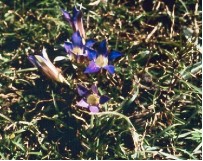
| Gentiana is a large genus of plants with great aesthetic value and are part of the family Gentianaceae consisting of about 300 species. The genus is widely distributed throughout the temperate and mountainous regions of Europe, North America and Asia. It is a beautiful perennial herb that grows to a height of 10 cm. The plant blooms with trumpet-shaped, violet coloured flowers. In India, the rhizome and root form a major ingredient of various Ayurvedic preparations. The plant has several medicinal uses and is used as a blood purifier, carminative and diaphoretic. The over-exploitation coupled with destructive harvesting for rhizomes and roots has endangered the plants’ survival and it is classified as critically endangered by the IUCN. It is urgently required to bring this plant under cultivation to ensure sustained supply of raw material and save the species from extinction. |
Habitat and ecology: The species is distributed over a wide range, occurring throughout the Himalayas, from Himachal to southeast Tibet. It grows on grassy hillsides, dry hillsides and alpine meadows at elevations of 4200 to 5300m.m and being a deep-rooted herb, it grows naturally in rock crevices and dry localities. It requires moist, well-drained soil and is intolerant to root disturbance.
|
| Morphology: It is a small, tufted herb with a perennial rootstock, giving out numerous arching stems that are 5-30 cm long. The leaves are basal, lanceolate and usually 10-12 cm long. They funnel-shaped flowers are blue and may have white spots. Usually, they are borne in pairs but may also be solitary. |
| Distinguishing features: The plant is a tufted herb, stout with long, basal leaves. The flowers are blue with the calyx half as long as the corolla. The corolla is five lobed and the capsule is oblong. |
| Life cycle: Flowering and fruiting occurs in the months of August-September. |
| Uses: The plant has several medicinal uses. The plant yields a bitter tonic, which is stomachic and a febrifuge. It is considered to be a blood purifier, carminative, diaphoretic and digestive. The entire plant is used in Tibetan medicine and acts as an antidote and has anti-fungal properties. The plant is used in the treatment of headaches, redness of the eyes, blisters in the mouth and inflammation of the throat. It is used for treating digestive problems too and is an input for medicines for jaundice, hepatitis, acute urinary infections, abdominal bloating and constipation. It is also used for treating inflammation of the gall bladder. It is used as a stomachic tonic, for enhancing appetite and as a digestive stimulant. Its extreme bitterness triggers the secretion of saliva, which in turn stimulates the production of gastric juices and bile, and prepares the digestive system to effectively process food. Gentian is one of the bitterest herbs and is therefore used as a bitter in food and for alcohol. The bitter is processed and available in the form of a powder, tincture or decoction. |
|
| |
|
|
 |
|
| Family: Gentianaceae |
| Common/local name: Indian Gentian, Karu, Kaur, Tryamana, Pakhanbed, Nilkant |
| Trade name: Kutki, Karu |
|
|
|
| File Size:276.0693359375kb |
|
|
|
| |
| |
|
|


