Himalayan VOICES High Himalaya FORUM Himalayan Heritage  
 
Search
 
 
View more Databases:
CULTURAL RESOURCES
Tribes
Socio-economic Fabric
Language & Literature
Art, Crafts & Architecture
 
Species:        Hippophae rhamnoides
Profile:

The plant is more famously known as sea buckthorn or Leh berry. The species grows widely in Asia and Europe and is commercially grown in China, Russia, Nepal and Pakistan. It is also a soil binder species and is used to conserve soil. The fruits are a rich source of vitamin A, B and C and a potential source of proteins, organic acids, carotenoids and flavonoids. The whole plant is a rich source of iron, cobalt, and molybdenum. The plant is presently in use in over 200 industrial products like medicines, cosmetics and health food products. The plant fixes atmospheric nitrogen and is found associated with species like Myricaria squamosa. Sea buckthorn is of immense value in conserving soil and the environment and a remarkable preserver of fragile high Himalayan ecosystem.

Habitat and ecology:   Sea buckthorn grows in temperate climates and is indigenous to the Ladakh region of Jammu and Kashmir, Chamba, Lahaul and Spiti district and Kinnaur of Himachal Pradesh, Kumaon and Garhwal of Uttarakhand and Sikkim. The plant is found gregariously growing along the riversides and moist patches of the cold desert Himalayas at an altitude of 1600-2500 m.
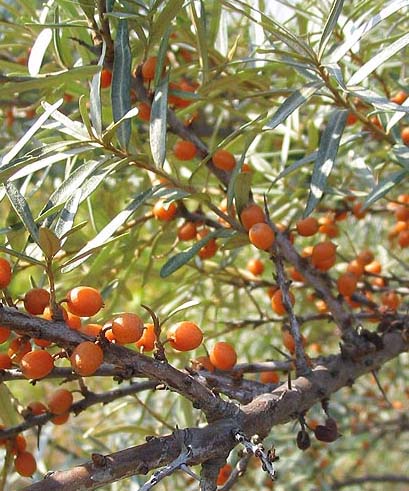
Morphology:   The plant is usually a varying sized thorny shrub. The shoot is modified into spines. The leaves are lanceolate-linear and obtuse with peltate and stellate scales on the lower surface. The male plant flowers in clusters at base of the shoot. The tepals are free and sub-orbicular. The fruits are subglobose, succulent and red or orange coloured. The seeds are solitary, uniquely lobed, light black and stony.
Distinguishing features:   Sea buckthorn is a dioecious shrub with an ashen brown coloured stem and 2-5 cm long spines. The fruit is a pseudo-berry turning from green to yellow-orange and red on ripening.
Life cycle:   The vegetative buds start sprouting by April as the snow melts. Flowering takes place in July-August and fruiting August- September.
Uses:  The plant has ethno-medicinal uses. It is regarded as a tonic and the pulverized berries are used to prepare medicines to cure tuberculosis. It is also used to cure various lung disorders. The fruits of sea buckthorn are a very important source of vitamins for the people living in the cold regions. The Amchis (traditional healers) of Lahaul in Himachal Pradesh use sea buckthorn to prepare medicines to cure lung disorders, blood pressure problems and indigestion. Amchis in Ladakh use this plant to cure amenorrhea. The vaids (traditional healers) of Joshimath use this plant as a blood purifier and anti-tussive. A paste of the leaves and roots is rubbed all over the body in case of pneumonia. It is very effective as a tonic during convalescence. The berries may be eaten in raw or taken as an infusion. The juice of crushed berries is used by ladies for cleaning ornaments. Cooked berries are used for the production of various products like jams, pickles and squashes. Its branches are used for fencing for the farmlands.  It is also used as insulation material for roofs in houses. It has also been serving as a traditional fuel wood in the treeless cold deserts. It has an important ecological use, as the plant is a nitrogen fixer and soil binder and hence used in wasteland reclamation.

 
Family: Eleagnaceae
Common/local name: Common sea buckthorn, Leh Berry, Amesh, khatai (Joshimath), Tarbu (Lahaul), Dhurchuk (Hindi), Tseta lulu (Ladakh), Chharma, Tir guk (Spiti)
Trade name: Sea buckthorn
File Size:192.484375kb
Download