| Profile: |
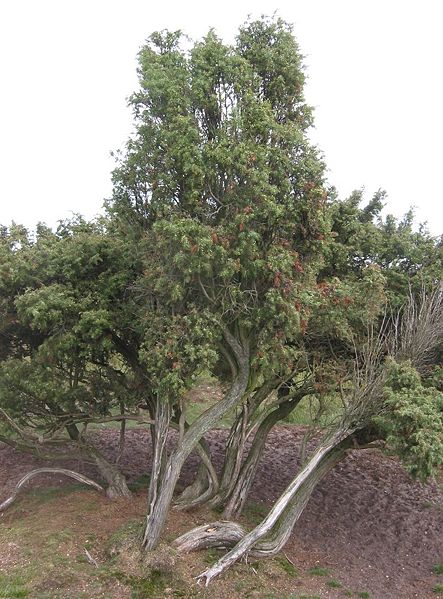
| Juniperus communis boasts of a strong roots in the rich culture of the Central Himalayas, and has enjoyed a highly prized status since ancient times, especially in the spiritual context. The reddish-brown bark peels off in the nature of parchment and the wood is finely veined and distinctly aromatic. The needle-like leaves are also aromatic. The plant bears blue flowers and is also called ‘the weeping blue Juniper’. The people of the Himalayas extensively use almost all parts of this shrub. The wood and the bark are used as a fuel wood that emits a sweet smell as it burns. The leaves and the berries are used as incense and in the preparation of medicines. |
| Habitat and ecology: J.communis grows wild in the temperate Himalayas from Afghanistan to Central Nepal at an altitudinal range between 1600-4500 m. It is well adapted to medium and high elevations in India. It prefers sunny and open areas and thrives well in drier parts, rather rocky and gravelly ground. In Himachal Pradesh, the plant grows between 3000-4500 m elevation in Chhota and Bara Bhangal, Rorag thatch in Kullu, Chounti, Kalga Pattan, Chansil, Chheradhank in Rohru Forest division, Chitkul and Sangla in Kinnaur, Mani Mahesh in Chamba and Churdhar in Sirmour District. It is also found in drier areas like Chalunka and in Kargil and Drass areas in Jammu and Kashmir. |
| Morphology: Junipers vary greatly in habit. They can be erect, columnar or pyramidal and those of bushy habit may be grown in hedges. The dense tufted spreading habit provides a good covering for the ground in wild places of high altitudes. It is a dense, more or less procumbent evergreen shrub and rarely a small tree. The plant is dioecious in habit with separate male and female plants. The stem is erect, branched and up to 1 m tall. The leaves are crowded, in whorls of 3, linear-globulate, sharply pointed, spreading nearly at right angles from the branchlets, rigid and aromatic with the upper surface concave, glaucous and bluish white. The flowers are usually dioecious and axillary. The berry like fruits are sub-globose and remain green for more than a year, turning bluish black when ripe. The plant is highly variable with a number of geographical varieties and garden forms. It becomes prostrate, not more than 60-70 cm in height at higher altitudes in the Himalayas. |
| Distinguishing features: The scale like needles are distinctive because of their bluish-green colour and characteristic smell when crushed. The fruits are green when young and turn black on ripening. |
| Life cycle: The plant starts flowering in second year in the month of March-April and fruit ripens in August-September. |
| Uses: The wood is used as fuel and is collected by the locals for the preparation of essence. The rectified oil is said to be a stimulant and diuretic because of the presence of junene and is prescribed in diseases of the kidney, urinary bladder and in conditions like hepatic dropsy, congestive cardiac failure (CCF), asthma, hemicranias, chronic bronchitis, dropsy and other diseases of the liver and spleen. It is also a stomachic and carminative in indigestion and flatulence. The oil is used in veterinary practices on exposed wounds and to prevent irritation from flies. It is also used for flavouring of beverages and liqueurs. Fresh berries are added to flavour alcoholic beverage like gin. Oil that has been purified twice has high flavour value. The wood is used as a substitute for guaiacum and sassafras and in the manufacturing of pencils. This plant is revered because it is believed to possess the power to propitiate evil spirits. It is therefore used for treating nervous disorders. The smoke of dried leaves and mustard seeds burnt together with ghee is believed to cast off evil spirits. This herb is used to cure kidney disorders. The oil possesses diuretic and carminative properties. Hence, in combination with other diuretics, it is used in various forms of dropsies (‘sotha’). It is also used to treat heart diseases. The oil extracted from the berries can be locally applied in some cutaneous infections inhaled as vapours or taken in the form of pills. It is useful for the treatment of mucous discharges. |
|
| |
|
|
 |
|
| Family: Cupressaceae (Conifereae) |
| Common/local name: Juniper, Hapusha, Shupa, Bitharh, Theleru, Chhershup, Chheshi, Hauber, Bethar, Pethri (Kashmir and Kumaon), Shukpa (Spiti, Lahaul), Hapusha (Bengali) |
| Trade name: Juniper, Hapusha |
|
|
|
| File Size:634.6875kb |
|
|


