| Profile: |
| Plantago major belongs to the Plantaginaceae family and is used in medicine and food. The plant has spread throughout the world by travelling Europeans and it was named "white man's footprint". This may be the reason for its scientific name, "Plantago", which is derived from a Latin word meaning "sole of the foot". |
| Habitat and ecology: It is a common weed of orchards, grasslands and vegetable fields. It is found in a wide range of habitats but it prefers relatively fertile open ground as well as pastures and arable land. The plant is found in areas stretching from Pakistan to Himachal Pradesh at an altitude of 4000-5400 m. It is common in temperate and alpine Himalayas and in Assam, Khasi hills, the Konkan region, Western Ghats, Nilgiris and Palneys and in Baluchistan. |
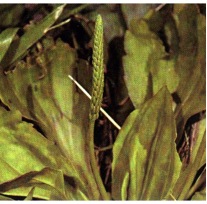
| Morphology: The plant is a perennial herb with an erect stout rootstock. The leaves are basal alternate, about 2.5-12.5 cm long, ovate or ovate-oblong obtuse or sub-acute entire or toothed nearly glabrous base, tapering and decurrent into the petiole and commonly seven nerved. The petioles are usually longer than the blade and there is broad sheathing base. The flowers are scattered or crowded in long slender, rather lax spikes that are 5-15 cm long. The bracts are 1.5-2 mm long, shorter than the calyx, broadly ovate-oblong, terete or ribbed obtuse with scarious margins. The calyx is 3 mm long, glabrous, oblong, obtuse or sub-acute, obtusely keeled on the back and with broad scabrous margins. The corolla is 4 mm long and glabrous and the lobes are lanceolate, acute and reflexed. The capsule is ovoid, 3-4 mm long and glabrous. The seeds are 4-8 angled, rugulose, ovoid, dull black and 0.85 mm long. Usually there are 8-16 seeds in a capsule. |
| Distinguishing features: The leaves form a rosette at the base and have a reddish petiole with wavy or lobed margins. The flowering spikes are 45 cm long and compact. |
| Life cycle: It is a perennial plant. The plant is in flowering stage in the months of May-September. Seeds ripen between July-October. |
| Uses: The leaves are edible and used in herbal medicine. The taste is very bitter with a lingering aftertaste. The leaves are dried to make tea. It is used in cases of eye irritation and pain, toothache, inflammatory earache, depression and insomnia. Traditionally it is used for treating bee stings, incised wounds and bleeding piles. The plant is also useful in rheumatism and griping pain in bowel movement. The leaves and roots are an astringent and used in fevers. They are also applied to bruises and are diuretic, alterative and cooling in nature. The seeds are used when suffering from dysentery, gastric complaints and burning sensation in stomach. The whole plant is useful in case of stomach upset. The leaves and roots are also used for dyeing cotton. Common plantain is a safe and effective treatment for bleeding. It quickly staunches blood flow and encourages the repair of damaged tissue. The leaves are demulcent, deobstruent, depurative, diuretic, expectorant, haemostatic and refrigerant. Internally, they are used in the treatment of a wide range of complaints including diarrhoea, gastritis, peptic ulcers, irritable bowel syndrome, haemorrhage, haemorrhoids, cystitis, bronchitis, catarrh, sinusitis, asthma and hay fever. They are used externally in treating skin inflammations, malignant ulcers, cuts, as a wet dressing for wounds and swellings. Distilled water made from the plant makes an excellent eye lotion. |
|
| |
|
|
 |
|
| Family: Plantaginaceae |
| Common/local name: Ripplegrass, Great plantain, Jangli Isabgol, Yakram, Jharamnaram, Lahuriya (Kumaon), Bartang, Gul (Kashmir), Ghuzbe, Karet (Punjab) |
| Trade name: Jangli Isabgol, Bartang |
|
|
|
| File Size:1574.3095703125kb |
|
|


