| Profile: |
| Jurinea dolomiaea is a plant belonging to the Compositae family, the largest family of flowering plants. It is a family of over 20,000 species in which the flower is actually a composite flower, consisting of a cluster of many tiny flowers called florets. The local inhabitants of hilly regions extract the roots and the entire plant is destroyed. This has resulted in depletion of the wild population in most areas of its occurrence. ‘Dhoop’ is a relatively safe plant and no hazards related to this plant are known till date. |
| Habitat and ecology: Jurinea dolomiaea is a prostrate perennial stem-less herb found in the Himalayas from Pakistan, Kashmir, Kumaon upto East Nepal at altitudes of 3000-4300 m. It is found scattered in open slopes, meadows, rock-crevices and glacier moraines. In Himachal Pradesh, dhoop is commonly found in alpine pastures and slopes between 3500-4500 m in Pangi-Bharmour (Mani-Mahesh), Dainasar and Thamsar of Kangra, Rorag thatch in Kullu, Chitkul, Sangla and Manjiban Kandas of Kinnaaur, Chandra nahan, Chansal, Goru, Kalgapattan and Muraldanda of Shimla district. |
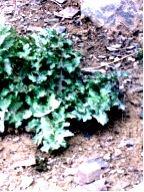
| Morphology: This is a prostrate perennial herb with a dense central domed cluster of large purple flower heads stretching upto 10 cm across. The flower heads are upto 4 cm long on a short stalk, are numerous, rosulate in umble-like heads, short peduncled, tomentose and often cottony at the base. Outer bracts are lanceolate and hairy, the achenes are curved, compressed, 4-5 angled, tubercled, and ashy-grey. The root is stout, softly aromatic, dark brown, perennial, and grows deep into the soil. Rootstocks are woody. The leaves are oblong, blunt in outline, and pinnately lobed, the lobes are toothed or shallowly lobed, white, wooly beneath, white and lanate above, spreading in a rosette like manner having a purple mid-rib. |
| Distinguishing features: This is a stem-less prostrate perennial with oblong-lanceolate, pinnatified radical leaves of purple mid-veins and with woody rootstocks. |
Life cycle: The plant completes its reproductive cycle within the months of June-September.
|
| Uses: The roots are considered to be stimulant and given in case of fever after the childbirth. Decoction of the roots is given in colic. Bruised roots are applied to eruptions. Aromatic oil from the roots is applied over the affected part in gout and rheumatism. Locally it is known as dhoop or Gugul and its tuberous roots are valued for incense in temples, monastries, houses and religious ceremonies. The woody rootstock is important medicinally and is collected by severing it with a sharp knife head. It is then cleansed, chopped and dried. Essential oils and aromatic resins are extracted from it. The plant medicine is also taken as a decoction. For this, the roots are boiled in water, which is then cooled and taken orally. The crushed roots are also administered to remit mental depression, excessive thirst, digestive disorders and dyspepsia. The plant material is also effective in healing eruptions. The aromatic oil extracted from the roots is applied over the affected part. The oil extracted from the plant is added to bathwater as it induces a feeling of freshness. |
|
| |
|
|
 |
|
| Family: Compositae/Asteraceae |
| Common/local name: Jhari-Dhoop, Dhoop (Lahaul), Gugul (Kinnaur), Dhoop lakkar |
| Trade name: Guggal Dhoop |
|
|
|
| File Size:254.6689453125kb |
|
|


