| Profile: |
| The plant was earlier called Podophyllum emodi. Bankakri or the Himalayan May-apple, as it is commonly known, is endemic to the temperate Himalayas. Although the plant is poisonous, it is valued for its medicinal properties, which are extracted after processing. |
| Habitat and ecology: The plant is found in forests, meadows and moist, shaded slopes in the altitudinal range of 2600-4500 m. It is known to thrive well as undergrowth in the fir forests rich in humus and decaying organic matter in the subalpine region. The associated species are Juniperus, Rhododendron, Salix and Viburnum. It is less frequent in open alpine meadows. It usually grows in protected places at the foot of the slope or between rocks and boulders, particularly in sites that offer deep soil and a steady water supply. It is found in Himachal Pradesh, sporadically in Rohru, Kullu, Kangra, Chamba, Nichar, and Lahaul-Spiti forest divisions, in Tawang, Arunachal Pradesh, North Sikkim, Changthang and Nubra valley in Ladakh and Chamoli and Pitthoragarh in Uttarakhand. |
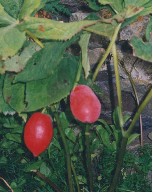
| Morphology: It is a sparingly branched, erect shrub bearing two large terminal leaves, which encircle a single, large, white or pink coloured flower. The fruit is an oblong, elliptic berry that turns red on ripening. The plant is a geophyte and has creeping knotted rhizomes about 2-5 cm long, 1-2 cm thick and bears countless roots. The stem of the plant is glabrous, unbranched and bears two large alternate leaves. The leaves are palmate, peltate and orbicular-reniform with deeply lobed segments. The flowers are cup-shaped and white or pink in colour, solitary and are found in the axil of the two leaves. The plant has three sepals that are petioled and 4-6 obovate and oblong petals. The fruits are elliptic or oblong berries, orange or red in colour and contain several seeds embedded in the red pulp. |
| Distinguishing features: The long stalked orbicular-reniform, palmate, peltate deeply lobed leaves are quite distinctive. The orange or red oblong elliptic berry is another striking feature. |
| Life cycle: The underground rhizomes remain dormant during winter and produce aerial shoots in April-May, depending upon the melting of snow and aspect. Flowering occurs in May and by September fruiting is over. After the flowering and fruiting is over, the shoot dies in November. |
| Uses: The plant material is effective in treating hepatic and gastric problems. It is also used for the treatment of gynaecological disorders and is used during childbirth for easing the delivery process. The pulverized fruits are prescribed for cough and cold and the powdered roots and rhizomes are a home remedy for chronic constipation. The plant is useful for treating skin diseases such as warts and tumours. In recent times it has been found to have anti-cancer properties, helping to inhibit mitosis and cancerous growth. The ripe fruits are edible and are relished by the local communities of the Himalayas. The rhizomes and roots are considered hepatic, stimulant, cholagogue, purgative and bitter tonic. Theresin or podophyllin is a drastic purgative and produces copious watery stools. It is thus, given with Belladona and Hyocyamus to avoid gripping. Podophyllin has also been tried on various diseases like warty lesions of the skin and neoplasms of the body parts. It is an effective vermifuge, first stimulating, then paralyzing and finally killing Ascaris. |
|
| |
|
|
 |
|
| Family: Berberidaceae (Podophyllaceae) |
| Common/local name: Indian Podophyllum, Himalayan May apple, Papra, Bakrachimaka, Bhavanbakra, Papri (Hindi), Banwagan (Kashmiri), Bankakri (Uttaranchal, Lahaul), Kanda ri-mokri, Giriparpat, Rikhpat |
| Trade name: Bankakri |
|
|
|
| File Size:271.826171875kb |
|
|


