Himalayan VOICES High Himalaya FORUM Himalayan Heritage  
 
Search
 
 
View more Databases:
CULTURAL RESOURCES
Tribes
Socio-economic Fabric
Language & Literature
Art, Crafts & Architecture
 
Species:        Meconopsis aculeate
Profile:

Meconopsis aculeate belongs to the Papaveraceae family, also known as the ‘poppy family’. The plants of this family are usually lactiferous. The family consists of 44 genera and 760 species. All the plants of the genus Meconopsis are misleadingly called Himalayan Blue Poppies, but it is interesting to note that the flowers of a few species of this genus are not blue in colour and do not belong to the Himalayas.

Habitat and ecology: The plant is found mostly in the Western Himalayas at an altitude of 2400-4500 m. It grows in rock crevices and amongst boulders in the alpine zones. The tender, easily withering leaves are typical for plants living in shady or semi shady habitats with a constant water supply amongst damp rocks, cervices and scree and along the banks of streams. The plant is restricted to the Western Himalayas and Kumaon in the Central Himalayas from Eastern Afghanistan to Kashmir and Zanskar (growing in open spaces) in India.

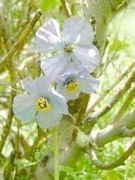
Morphology:   This is an erect, bristly, perennial herb, 40-60 cm tall. The radical leaves are long petioled, up to 20 cm long, irregularly and pinnately lobed. The lobes are rounded, with numerous bristles arising from the surface and along the margins. Cauline leaves are similar but sessile. The flowers are large, sky blue to purplish blue, and are racemosely arranged at the apex. The colour of the flower varies. The flowers are blue at the beginning of the flowering time and changes to a more reddish colour when withering. Each flower has 2 sepals, 4 petals, numerous stamens and yellow anthers. The capsule dehisces by 4-6 valves, 1-1.5 cm long. The seeds are sub-reniformed. The stem is stout and densely bristly.
Distinguishing features:    The plant is a 40-60 cm high prickly herb with pinnatified leaves and blue-purpled flowers that are 5-8 cm across.
Life cycle:  This perennial herb completes its seed to seed life cycle in one year. With flowering in the month of July-August, seeds develop by the end of September and get dispersed by wind. These seeds remain in open throughout the winter and start germinating next year when the snow starts melting. Such seedlings start flowering in the same year in the months of July-August and seed development takes place. However, seed development of the flowers of second year or more old plants is comparatively much better.
Uses:   It is used as a febrifuge and analgesic. It is used to treat inflammation from fractured or broken bones and pain in upper body especially around the ribs. Powdered aerial parts of this plant are given as a tonic for general weakness. The roots are used to treat renal colic and backache. The flowers and roots are used to treat cardiac ailments. The drug is also administered in the form of a decoction and a hot infusion. It is used in treating fever and as a painkiller.


Family: The Himalayan Blue Poppy, Kanta, Kanda, Chharbongcha and Chharmen
Common/local name: Kanda, Kanta
Trade name: Kanda, Kanta
File Size:3253.619140625kb
Download