| Profile: |
| The Lamiaceae family has about 250 genera and 6700 species, including herb and garden plants like lavender, sage, basil, rosemary and mint. The genus Mentha consists of about 20-30 species that are mainly found in the temperate region. This plant has a strong peppermint-like aroma. The plant spreads via rhizomes and grows to cover an indefinite area. Like almost all mints, Mentha longifolia is invasive and care needs to be taken when planting it in non-controlled areas. |
Habitat and ecology: It can grow in semi-shade light woodlands or no shade. It requires moist soil. The plant can tolerate strong winds but not maritime exposure. The plant is commonly found in bogs, streamsides, irrigation canals, marshy places, along glacial streams, growing in abundance in moist nallahs and ravines. Grows well in heavy clay soils. The herb is found in the temperate Himalayas and Western Tibet at the altitudes of 1200-3600 m. It is also found in Kashmir, Himachal Predesh, Garhwal and Kumaon, stretches of Pakistan to Central Nepal, Tibet, Northern and Western Asia and in Europe. The altitudinal range of the plant varies between 1500-3800 m. In Himachal Pradesh it is found in almost all the districts of the state above 1200 m. It grows up to 4800 m in Spiti, especially in Sangam, Gulling, Gheego, Rangrik top, Gue and Kibber.
|
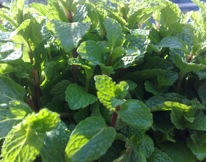
| Morphology: It is an aromatic, hairy perennial, with tiny lilac flowers in whorls, forming slender spikes, often interrupted below, borne at the ends of branches and forming a lax densely hairy inflorescence. The flowering spikes are 2.5-8 cm long and 8-12 cm broad. Flowers are 3 mm across, hairy and the outside stamens are exerted. The calyx has 5 triangular lobes and the bracts are lanceolate. The leaves are oblong-obovate to lanceolate, saw toothed, with rounded base, densely hoary and paler beneath. The stems are 30-100 cm long. The flowers have short hairy pedicels. The whorls are usually continuous but occasionally interrupted. The nutlets are reticulate. |
| Distinguishing features: This is an erect or diffuse, aromatic, tomentose herb with white pubescent, lanceolate and toothed leaves. The flowers are pink in slender terminal spikes. |
| Life cycle: Flowering occurs during the months of July-August. |
Uses: Wild mint is a popular traditional medicine. The plant is applied to the wounds of animals to kill maggots. It is mainly used for respiratory ailments but many other uses have also been recorded. The leaves are used to make a tea for coughs, colds, stomach cramps, asthma, flatulence, indigestion and headaches. Externally, wild mint has been used to treat wounds and swollen glands. It is also used to keep mosquitoes away. It is an anti-bacterial, anti-spasmodic, stimulant and used in gall-bladder complaints, diseases of the liver, weak nerves, arthritis, for intestinal complaints and as carminative. But it is best not to be used by pregnant women because large doses can cause an abortion. The peppermint-scented leaves are consumed raw or cooked. They are used as flavouring in salads, chutneys and cooked foods. Herbal tea is made from the leaves. An essential oil obtained from the leaves and flowering tops is used as a food flavouring in sweets etc.
|
|
| |
|
|
 |
|
| Family: Ranunculaceae |
| Common/local name: Horsemint, Biblical mint, Long-leaved mint, Podina, Jangli pudina, Safed pudina, Chachri |
| Trade name: Pudina |
|
|
|
| File Size:238.5400390625kb |
|
|


