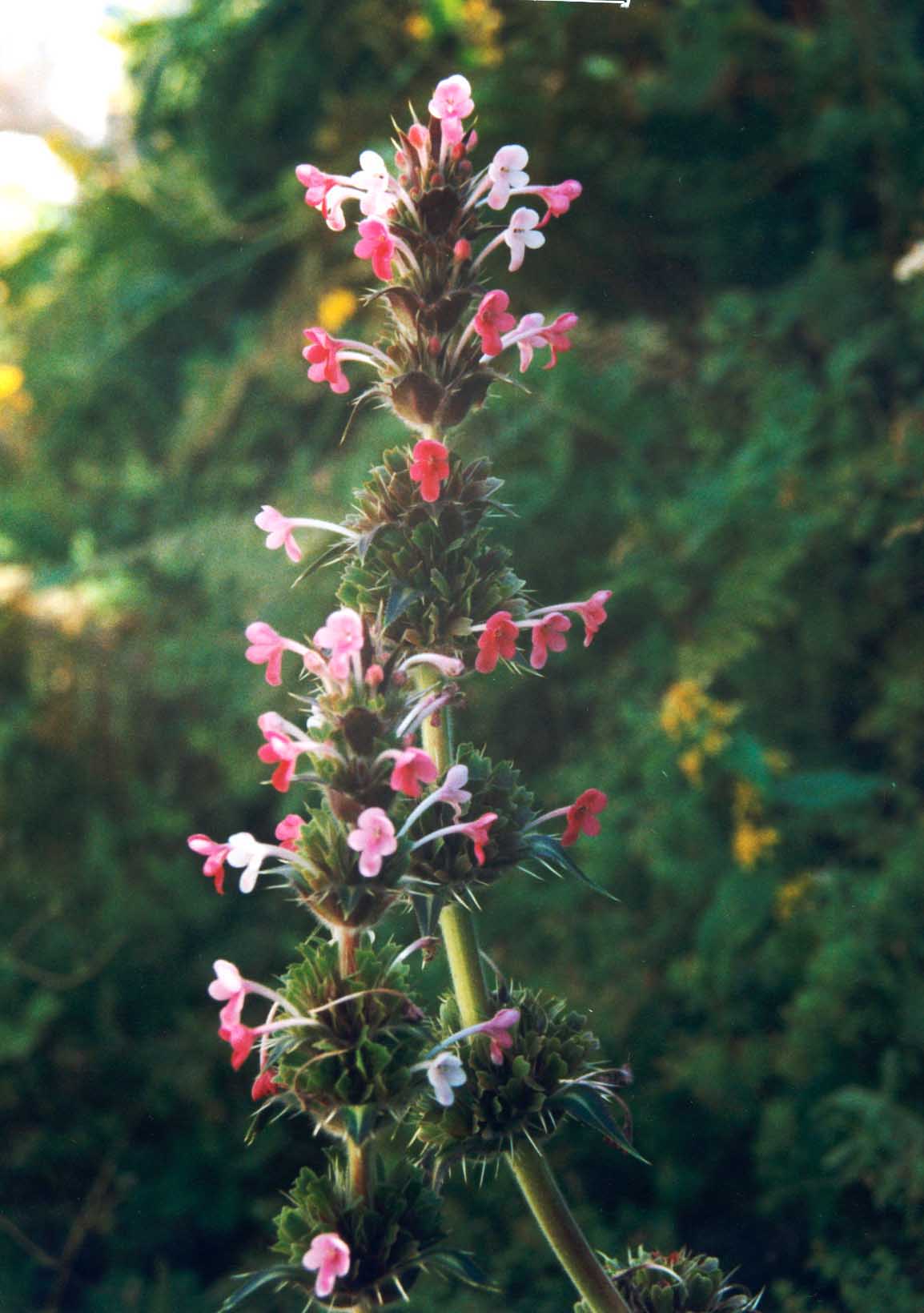
Morina are named in honour of Rene Morin, a French nurseryman who produced the world's first plant catalogue in 1621 called Catalogus plantarum horti Renati Morini. Morina longifolia is an elegant plant with dark and glossy foliage.
Habitat and ecology: It is a perennial plant that grows at an altitudinal range from 3000-4000 m. Open slopes and alpine shrubberies are the common habitat of the plant species. It is found distributed from Kashmir to Bhutan.
Morphology: This plant has spiny-margined leaves and a long interrupted spike of flowers, white to rose-pink in colour and paired bracts in subtending whorls with an enlarged ovate base and fused below. The flowers have a long slender corolla tube of length up to 2.5 cm and a 2-lipped hairy, calyx with acute or blunt lobes. The strap-shaped leaves have shallow 3-spined lobes and a long-pointed spiny apex, while the stem leaves are fused in a sheath at the base. The flowering stems grow up to 1 m and are hairy.
Distinguishing features: The plant has spiny-margined leaves and a long interrupted spike of flowers. It is attractive, glossy, thistly foliage, and flower spikes appear in late spring to summer.
Life cycle: The life cycle of this plant is from June-September.
Uses: The plant has several medicinal uses. The stem, leaves and flowers are used in Tibetan medicine. They have a sweet and astringent taste with a healing potency. They are digestive, emetic and stomachic and are used in the treatment of stomach disorders such as indigestion, vomiting and nausea. The plant is also used as incense. The roots yield an essential oil.