| Profile: |
| Peonies are herbaceous perennials arising from thickened tuberous roots. Largely invisible, hidden underground most of the year, they are quite spectacular when they emerge. Peonies are one of the longest living, herbaceous perennials, often found in the older gardens, for once established they will survive neglect. Peonies can live upto one hundred years. The generic name Paeonia is derived from Paeon, the physician God who first discovered the plant. Paeonia emodi is named after the latin for Himalaya, Emodi Montes and the Western range of the Himalayas is its home. Paeonia emodi has been exploited from the wild for long and there has been little effort for its commercial cultivation. Due to over-exploitation from the wild, the status of the species is dwindling. The species has already been endangered in the Western Himalayas. |
Habitat and ecology: The species requires sunny or partial shade places to grow. Sandy loam soil is preferred. The plant requires moist and well-drained soils and cannot tolerate waterlogged conditions. It is found in the Northwest Himalayas from Kashmir to Kumaon at an altitudinal range of 1600-3000 m.
|
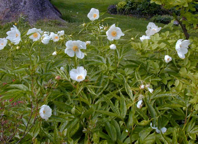
Morphology: It is a glabrous, perennial herb. The stem is 30-60 cm tall, leafy and erect. Leaves are alternate and 15-30 cm long. The plant has 3 leaflets. Usually there are 3-parted segments that are lanceolate, pointed and entire. There are a few flowers. They are showy, 7.5-10 cm across, long-stalked, usually solitary in the axils of the upper leaves. Buds are globose, there are 5 sepals, orbicular, concave, green, persistent; the outer ones ending in a leaf like point. There are 5-10 petals, broadly ovate, concave, red or white. There are many stamens; 1-3 ovaries, which are densely hairy, many ovuled, and the style is short. Follicle is ovoid and approximately 2.5 cm. The seeds are few and large in size.
|
Distinguishing features: It is a shrubby perennial of 30-60 cm height with large, deeply cut leaves and large, white flowers having numerous, orange-yellow stamens and persistent, outer sepals. Fruit is usually a single follicle, scarlet in colour with brown-black seeds.
|
| Life cycle: Flowering and fruiting takes place in May-June. |
Uses: The plant has several medicinal uses. It is a CNS (Central Nervous System) depressant, hypothadermic, diuretic and anti-inflammatory. Fleshy roots are used in the intestinal and uterine diseases. They are also useful in gout, biliousness, dropsy, epilepsy, convolutions and hysteria. The plant is used as a blood purifier for children. The infusion of the dried flowers is a highly valued remedy for diarrhoea. Tubers and seeds contain a toxic alkaloid that produces contraction of the renal capillaries and increases the coagulability of blood. Some monoterpenes isolated from the plant have been found to be anti-coagulative and sedative. They showed anti-inflammatory activities in neuromuscular junction. Seeds are cathartic. Vaids of Joshimath have been using it as an antispasmodic. Paeonia emodi is a traditionally important medicinal herb of Western and Central Indian Himalayas, which has been found to be beneficial in convulsions and insanity. It is also useful in hepatic, renal, cystic and dysmenorrheal pains. ‘Svetamoola’ in the famous Indian pharmacological literature of ‘Drvyaguna’ has been mentioned for controlling the excess of mucus formation in the body. It removes morbidity and promotes digestion, assimilation and tissue building. The plant also gives fitness to the body. It is bitter in taste but is a good appetizer and sialagogue. The plant increases potency as it helps in storing up of energy.
|
|
| |
|
|
 |
|
| Family: Ranunculaceae |
| Common/local name: Chandra/Himalayan peoni, Chandra (Joshimath), Udsalap (Hindi), Svetamoola (Sanskrit) |
| Trade name: Himalayan Peony |
|
|
|
| File Size:980.7763671875kb |
|
|


