| Profile: |
|
The perennial rhizomes and stolons are collected from the plant, generally in the month of October in the post-fruiting stage, as the alkaloid content is highest during this time. They are then chopped into smaller pieces, cleaned, dried in the shade, and finally stored in airtight containers.
|
| Habitat and ecology: The plant grows well on exposed slopes where abundant sunshine is available to facilitate the spread of the rhizomes. It is commonly seen associated with herbs like Aconitum violaceum, Lagotis cashmeriana, Sedum ewersii and Senecio jacquemontiana in the Western Himalayas. In the Central Himalayas, the most common associates of the species are Gaultheria trichophylla, Potentialla sibaldii and Rhododendron anthopogon. The plant is found in the alpine Himalayas from Kashmir to Sikkim, at the elevation of 3000-4000 m at rocky slopes. In Himachal Pradesh, it is found in the Thamsar and Dainasar areas of Bara and Chhota Bhangal respectively in Kangra district, Pangi, Bharmour of Chamba district, Lahaul, Kinnaur, Rohtang Pass in Kullu and in Shimla districts above 3200 m. |
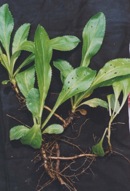
| Morphology: It is a perennial, creeping herb with jointed zigzag underground stems (rhizomes) giving off shoots at joints and also rooting at nodes. The leaves are spathulate and dentate forming tufts, which sit on the ground in loose groups, because they are produced at the ends of stout, creeping underground rhizomes. Some of them bear stalked, dense racemes of small, pale blue flowers. The basal leaves are 5-15 cm long, spatulate to narrowly elliptic, coarsely saw-toothed and taper into a winged petiole. The flowers are bluish white, showy and are borne in racemes of 10-15 cm length on a scape of about the same length, which bears a few (usually two to three) bract-like leaves. The flower scapes are stout, hairy, and longer than leaves. The corolla is about 8 mm long, five lobed to the middle with four conspicuously protruding stamens (usually four to five times the length of the corolla). The capsule is 6-10 mm long, ovoid attenuate, laterally slightly sulcate, surrounded by five persistent sepals. It contains numerous seeds that are up to 1.5 mm long. The large, elliptical leaves crowd the stem; the purplish blue flowers are borne on the apex of long, floral stalks. |
Distinguishing features: The plant has distinct purplish blue flowers that are borne on the apex. The roots are greyish-brown in colour and have transverse cracks and scars.
|
| Life cycle: The sprouting of vegetative shoots starts with the melting of snow towards the end of June or early July. The flowering occurs in mid summer usually during August followed by the ripening of the capsules and seed shedding in the month of September, by the month of October, this is then ready to enter into the dormant phase. |
| Uses: In small doses, it is a bitter stomachic and laxative, and in large doses, a cathartic. It is reputed as an anti-periodic and cholagogue. In Unani system of medicine, it is used externally in skin diseases and has also been found to be effective in the treatment of epilepsy, paralysis, emmenagogue and an antidote in case of being bitten by a dog. It is also reputed to have a beneficial action in dropsy and is considered as an appetiser, blood purifier and is used in cases of high blood pressure, cardiac problems, jaundice, asthma, cough, cold and bile trouble. It is a febrifuge and expectorant and is used to treat leprosy. The plant is a valuable bitter tonic. ‘Tiktaskandha’, as per the classification of herbs in the ‘Charaka Samhita’, an ancient Ayurvedic classic, it is used for the treatment of various ailments. Further, clinical trials on this drug have shown its therapeutic efficacy in asthma and arthritis. In the hilly regions of Kumaon and Garhwal, kutki is reputed as an appetiser and blood purifier. In conditions like loss of appetite, impaired liver functioning, etc. a cup of cold infusion of kutki is taken everyday morning on an empty stomach. |
|
|
| |
|
|
 |
|
| Family: Scrophulariaceae |
| Common/local name: Black Hellebore, Hellebore, Indian gentian, Kutki, Titka, Karvi, Picrorhizza, Kutuki (Uttaranchal), Kaur, Karru (Kinnaur & Lahaul), Honglin (Spiti) |
| Trade name: Karru, Kutki, Picrorhiza |
|
|
|
| File Size:2124.72265625kb |
|
|


