| Profile: |
| The name Rhododendron comes from the Greek word ‘rodon’, which means rose and ‘dendron’, which means tree. Rhododendron flowers are usually produced in trusses. Rhododendrons are also called ‘king of shrubs’ as they are regarded as the best flowering evergreen plants of the temperate region. The species Rhododendron anthopogon was discovered by David Don, a British botanist. |
Habitat and ecology: The plant is generally found above tree level, usually on the northern aspect of the slopes. It often forms dense gregarious patches on steep or boulder-strewn grounds. The plant succeeds in humus-rich, lime-free soil except the soils that are of a dry, arid nature or those that are heavy or clayey. It prefers a peaty or well-drained sandy loam. It can tolerate a pH between 4.5 and 5.5. The plant is found in the Himalayan region from Kashmir to Bhutan at an altitude of 3000-5200 m. In Himachal Pradesh, the bush is found in Chansal peak rocks, Chansal–dhamkari, Chounti slopes, Buraskandi, Mani-Mahesh, Rohtang peak, Thamsar and Dainasar areas between 3200-4500 m.
|
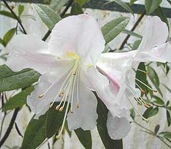
| Morphology: The leaves are crowded towards the end of branches, shortly stalked, leathery, and entire. The leaf blade is slightly thick and covered with smooth hairs. The leaves are 2.5-4 cm long, elliptic or broad-oblong, shining above and brown tomentose beneath having a short petiole. The flowers are yellow and in dense, terminal corymbs; the calyx lobes are oblong, elliptic, membranous or ciliate. The corolla is tubular with a dilated mouth. There are 6-8 stamens. The stigma is capitulate. The capsule is cylindric, woody, 5 or 10 valved. The ovary is scaly and the capsules are 0.5 cm long and ovoid. Seeds are oblong and sub-acute. The flowers are hermaphrodite (have both male and female organs) and are pollinated by insects. |
Distinguishing features: This highly aromatic shrub or scrub can be easily identified by its sulphur coloured flowers, salver-shaped corolla and by its aromatic odour.
|
| Life cycle: This species is in leaf all year. Flowering of the plants occurs in summer, generally from June-July. Fruiting takes place in autumn season, in the months of October-November. |
| Uses: The leaves possess stimulant properties and generally the flowers and the leaves of this plant are used as medicine. The leaves of this plant are aromatic, stimulant and administered as an errhine. This plant is used for all kinds of cold disorders. A bath prepared from the leaves is useful in treating diphtheria and sudden swelling. The powder of leaves is also used as incense. It is used in the treatment of gonorrhoea and stomach ailments. The flowers are used as a substitute of tea. In Nepal, the leaves are boiled and the vapours inhaled to treat coughs and colds. The flowers are anti-tussive, febrifuge and tonic, being used in the treatment of inflammations, lung disorders and general weakness of the body. |
|
| |
|
|
 |
|
| Family: Ericaceae |
| Common/local name: Dhoop, Rattanbat, Talisri, Talisptara, Nichni, Nera, Morua, Talsar, Ballu, Kaizaban |
| Trade name: Dhoop, Talispatra |
|
|
|
| File Size:197.3203125kb |
|
|


