| Profile: |
|
Rheum is a genus of perennial plants that grow from thick, short rhizomes. The genus consists of about 60 species. Rheum species are said to be larval food plants for some Lepidoptera species. The species is also referred to as Rheum emodi. The leaves of this species are poisonous as they contain oxalic acid. The species contains many active compounds such as tannins, volatile oils, anthraquinone derivatives, fatty acis, calcium oxalate etc.
|
Habitat and ecology: ‘Indian rhubarb’, as this plant is commonly called, is abundant in the Western and Central Himalayas, at altitudes ranging from 3300-5200m, on well-drained, alpine slopes and on rocky outcrops. It is found in the alpine zone. Generally it is found in moist type of climate where there is no dearth of moisture or near water streams, on the banks of rivulets etc. However, it is important to note that in Spiti, it is found in comparatively dry type of climate, compared to Kinnaur where precipitation is more as well as soil type is much better and more suitable for cultivation. The herb is distributed in the Himalayas from Kashmir to Sikkim. In Himachal Padesh, it is found growing in Chhota Bhangal and Bara Bhangal of Kangra, Pangi-Bharmour of Chamba, Parvati Valley of Kullu, Dodra Kawar, Khashadhar and Rohru ranges of Shimla district, Kinnaur district, and Lahaul and Spiti district.
|
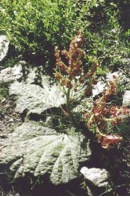
| Morphology: This is a robust perennial herb with very thick, long roots and is 1-15 m tall. The stem is stout, and is streaked green and brown with rounded leaves. The lower leaves are 20-50 cm in diameter, orbicular and are broadly ovate. The flowers are small and red to dark purple in colour. The fruits are purple with narrow wings, with a rounded heart-shaped base and notched apex. |
| Distinguishing features: Its leaves are quite big. The leaves are shining and the flowering stem is quite distinctive, bearing brown coloured numerous flowers on a single spike. |
| Life cycle: The plants remain dormant during winters from November-March depending upon the climatic conditions and environment. Generally new shoots grow up from previous years roots in the months of March-April when snow starts melting. During June-July the plants start flowering and once the vegetative phase is over, fruiting takes place generally in the months of August-September. |
| Uses: The rhizome is used as a purgative, astringent, tonic, stomachic and also in dyspepsia. The rhizome paste is used treat rheumatism. It is also used to plaster the sprains and swellings in people and cattle. The root powder is sprinkled over ulcers for quick healing and is used to clean teeth. A paste of the rhizome is applied on cuts to induce fast healing and also used to treat animals. The roots with madder and potash are used for dyeing fabrics red. The petioles, leaves, leaf-stocks and flowers are edible. Rheum is used to cure stomach problems and in the treatment of indigestion and flatulence, and also as a purgative. It has an impact on epidemic fever and is an indisputable cure for asthma and bronchitis. It is used for injuries and skin diseases and to reduce swellings or sprains. In Himalayan households, the plant material finds innumerable uses. It is used for stomach problems in infants. Root applications are used for cuts, wounds, muscle swellings, tonsillitis, mumps, ulcers, etc. Rheum is used to take out the pus from sores and wounds. Reddishness of eye caused from injury is also treated with Rheum. The delicate stems and stalks are pickled, boiled or eaten raw. The root powder is used for cleaning teeth and along with other inputs for dyeing fabric. The Rheum leaves, which are quite stiff, are rolled in the shape of a pipe, stuffed with tobacco and smoked. It is also an appetizer. |
|
| |
|
|
 |
|
| Family: Polygonaceae |
| Common/local name: Indian Rhubarb, Himalayan Rhubarb, Revand chini (Urdu), Revatchini, Gandhini, Chukri,Archa, Chuchi, Tukshu, Motininai, Rhubarb, Ushare-revand. Dolu (Uttaranchal), Leechu (Spiti), Archa (Kinnaur), Arpso (Lahaul) |
| Trade name: Ravand chini |
|
|
|
| File Size:392.0322265625kb |
|
|


