| |
|
|
| Species: Meconopsis paniculata |
|
|
| Profile: |
| This genus contains some of the most exquisitely beautiful, flowering herbs of the high altitude Himalayas. The population of this species is decreasing in the wild due to reducing habitats and harvesting. The species has been declared endangered. |
| Habitat and ecology: The plant is found at an altitudinal range of 3000-4100 m. It is found commonly on open slopes and grazing grounds. These plants need cool summers and prefer moist, leafy, humus-rich, acidic soils. The plant species is distributed in the central and eastern Himalayas covering Nepal, Bhutan and the Indian states of Sikkim and Arunachal Pradesh. |
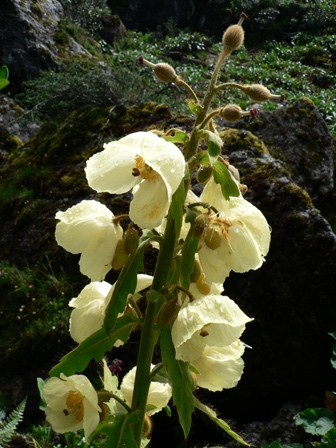
| Morphology: This robust plant grows up to 2 m in height, with a long, cylindrical, terminal cluster of large yellow or occasionally white nodding flowers and dense, golden, bristly-haired, pinnate lobed, lanceolate leaves. The upper flowers are stalked and single, while the lower flowers are borne on branched stalks from the axils of the upper leaves. The petals are usually four in number and rounded. The basal leaves are in dense rosettes and about 90 cm long, variously cut in to lanceolate, toothed lobes. The upper stem-leaves are clasping, all covered with long bristly hairs and short star-shaped hairs. The fruits are ellipsoid-oblong in shape, dense and bristly-haired. |
| Distinguishing features: It is an erect, robust herb with terminal cluster of yellow or white flowers and dense. |
| Life cycle: Flowering takes place from June-August and fruiting takes place in August-September. |
| Uses: The roots have narcotic properties. The Sherpas eat these roots in salads. The seeds yield a drying oil. |
|
| |
|
|
 |
|
| Family: Papaveraceae |
| Common/local name: Golden Himalayan Poppy |
| Trade name: Data not available |
|
|
|
| File Size:0kb |
|
|
|
| |
| |
|
|


