| |
|
|
| Species: Rhododendron campanulatum |
|
|
| Profile: |
| The Rhododendron genus is very large, comprising around 900 species. Rhododendron campanulatum has two subspecies: R. capanumaltum ssp. campanulatum which is a tall bush with white-pale lilac flowers and is found from Kashmir-Sikkim at an altitude of 3000-4200 m and R. capanumaltum ssp. aeroginosum which is a shrub with pink-purple flowers and is found from Sikkim-Bhutan at higher altitudes of 3700-4500 m. The leaves of the plant are poisonous and should not be ingested. |
| Habitat and ecology: The plant is widely spread from the western Himalayas to western Tibetan region at an altitudinal range of 3000-4400 m. It prefers well-aerated soil and is susceptible to root rot. The plant grows in most humus rich lime free soils except those of a dry arid nature or heavy or clayey. It is found in the alpine forests and shrubberies. In Himachal Pradesh, it forms vast rambling patches in Chansil, Thamsar base, Dainasar pastures, Mani-Mahesh, Rorag thatch in Parvati Valley, Muraldanda, Shikari devi in Mandi and Churdhar in Sirmour district. |
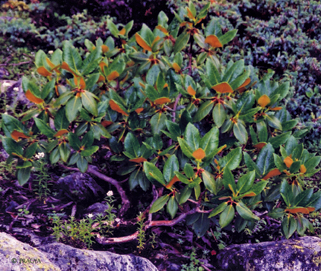
| Morphology: It is an erect, dwarf shrub with a wide branching behaviour and greyish-brown coloured bark. The plant is characterized by 9-14 cm long, elliptical to ovate, alternate leaves that are glabrous on the upper surface. The plant attains an average height of 1 m and a spread of 2-6 m. The lower surface is characterized by typical brown indumentums. The pale mauve to lilac shaded, bell-shaped flowers are arranged in lax clusters. The petals are 5 lobed and fused at the base. The fruit is a dry capsule with oblong, compressed seeds. |
| Distinguishing features: The plant is characterized by oblong, elliptical, evergreen leaves with rusty-brown, fulvous tomentum on the under surface. The hairs are reniform or carpitellate in nature. |
| Life cycle: The plant is in flowering stage in May-July and bears fruit in the months of October to December. It is in leaf all year. |
| Uses: The roots of the plant are used to treat boils. The leaves are used for rheumatism, syphilis and sciata. They are mixed with tobacco and used as snuff to cure hemicrania and colds. The leaves are poisonous when ingested by livestock. The flowers yield an essential oil. The wood is an excellent fuel but the smoke is acrid and an irritant. |
|
| |
|
|
 |
|
| Family: Ericaceae |
| Common/local name: Rhododendron, Shargar, Simrath, Simrung, Gaggar, Kashmiri-patha Nichnai |
| Trade name: Cherailu |
|
|
|
| File Size:457.8203125kb |
|
|
|
| |
| |
|
|


