| |
|
|
|
| Profile: |
| The Rumex genus includes around 200 species of different types of sorrel. Rumex acetosa is a perennial herb often cultivate in gardens. The plant has high levels of oxalic acid, which gives the leaves an acid-lemon flavour. |
| Habitat and ecology: It is widely distributed from Afghanistan to Central Nepal and in temperate Eurasia, Europe and North America at an altitude of 2100-4300 m. It is common in the western Himalayas from Kumaon to Kashmir, between 2500-3700 m. This perennial plant occurs on moist slopes, shaded areas and shrubberies. The plants can grow in very acidic soil. |
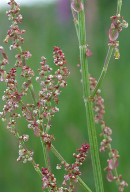
| Morphology: Rumex acetosa has simple, leafy, striated stem and a long and tapering, somewhat woody root. The lower leaves are petiolate, ovate and arrow-shaped with two lateral teeth. The flowers are dioecious with male flowers being green in colour with a reddish tinge and female flowers being relatively redder. The flowers are numerous and are pollinated by wind. The root of the plant is astringent. |
| Distinguishing features: The perianth is in 2 whorls of 3 segments, becoming wing-like and open hardened in the fruit. The nutlets are 3-angled. |
| Life cycle: This perennial herb completes its seed to seed life cycle in two years. Flowering generally takes place in the months of July-August and the seeds become matured by end of September and starts dispersing with wind. These seeds remain in open throughout the winter thus meet their winter chilling requirement in nature. Such seeds start germinating the following year with the melting of snow. By the end of that very year plant-lets get established in the field and in the second year of their growth they start flowering; produce seeds thus completes their seed to seed life cycle in two years. In successive years of their growth seed set gets enhanced substantially. |
| Uses: This plant is used to treat scurvy. The leaves are used as a refrigerant, are diuretic, and as a cooling drink in febrile diseases in Europe. Fresh stem and leaves are consumed for quenching thirst and also for edible purpose. In Lahaul valley, its ethno-botanical use has been recorded as a laxative and also against stomach disorders among the local inhabitants. The leaves are used in bronchial diseases, in homeopathy, for skin troubles and convulsions, and also in cutaneous tumours. The leaves are also consumed raw or cooked. The root is dried, ground into a powder and made into noodles. The seeds are ground into powder and mixed with other flours to make bread. The juice of the leaves can be used as a curdling agent for milks. The fresh or dried leaves are astringent, diuretic, laxative and refrigerant. The leaf juice, mixed with fumitory, has been used as a cure for itchy skin and ringworm. An infusion of the root is astringent, diuretic and haemostatic. It has also been used in the treatment of jaundice, gravel and kidney stones. A paste of the root is applied to set dislocated bones. Dark green to brown and dark grey dyes can be obtained from the roots, and they do not need a mordant. A grey-blue dye is obtained from the leaves and stems. An infusion of the stems is used as a polish for bamboo and wicker furniture and also for silver. The juice of the plant removes stains from linen and also ink stains from white material. The leaves should not be eaten in large amounts since the oxalic acid can lock-up other nutrients in the food, especially calcium, thus causing mineral deficiencies. People with a tendency of rheumatism, arthritis, gout, kidney stones or hyperacidity should take especial caution if including this plant in their diet since it can aggravate their conditions. |
| |
| |
|
|
 |
|
| Family: Polygonaceae |
| Common/local name: Dock Sorrel, Sorrel, Tsok–tsin, Surjilove, Khatta Palak, Shoma |
| Trade name: Sorrel, Dock Sorrel |
|
|
|
| File Size:245.720703125kb |
|
|
|
| |
| |
|
|


