| Profile: |
| Taraxacum officinale is perhaps one of the most widely found weeds in the world. It is also one of the oldest and most versatile of the healing herbs. The plant has shiny-toothed leaves, which give the plant its common name of dandelion (an adaptation of the French ‘dent de lion’ or lion’s tooth). The plant is harvested mostly in the autumn months when the aerial parts have shrivelled |
| Habitat and ecology: This small herb is found as a weed in fields, roadsides, grasslands, wastelands, grassy meadows and moist shaded places, from plains up to alpine grasslands. It is found throughout the temperate Himalaya, in the Khasi Hills of Meghalaya, Mishmi hills of Arunachal Pradesh and in the hills of South India at altitudes of 300-5400 m. It is quite common in Himachal Pradesh and Uttarakhand as well. |
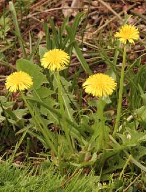
| Morphology: This is a small, erect, perennial herb, which grows in a rosette form against the ground, 5-20 cm tall, with milky latex. The rhizome is thick, vertical, almost passing into a tap-root, generally 15 cm long, sometimes up to 45 cm, 1.5-2.5 cm in diameter, nearly cylindrical, fleshy, crowned above with several short, thick remains of leaves, with numerous scars on the rootlets. The leaves are glabrous, sessile, narrowly oblong, 5-20 cm long, irregularly lyrate, pinnatifid and arranged in a basal rosette. The flower heads are 0.8-5.0 cm in diameter, solitary on hollow leafless peduncles and bright golden yellow in colour. The ligulate florets are golden-yellow, the achenes ob-ovoid, ribbed, glabrous, flattened and spindle-shaped. |
| Distinguishing features: The herb milky latex and golden-yellow ligulate florets. The Taraxacum root can be readily distinguished by its ringed appearance that it exhibits when broken or when a traverse section of the root is made. The yellow central axis is also a good distinctive mark of the Taraxacum root. These characteristic marks are most evident in the dried root. |
| Life cycle: The plant flowers in early spring at lower altitudes and up to September in the high altitude pastures of Spiti, Dodra-Kawar and Kinnaur. |
| Uses: The rhizome and roots are used commercially and for medicinal purposes. They constitute a drug called taraxacum, used as a mild laxative. In the Lahaul valley, fresh leaves are used as bandages on cuts and injuries. In Spiti, the powdered capitula is used to cure headache and fever. It is more commonly regarded as slightly tonic, blood purifier and diuretic. It appears to have an almost specific action on the liver and kidney. On the liver it acts by modifying and increasing its secretion. Hence it is extensively employed in chronic diseases of the digestive organs, especially hepatic affections like jaundice chronic inflammation or enlargement of liver, dropsy from hepatic obstruction and dyspepsia with deficient biliary secretion. Extracts prepared from the pollen shows antibiotic activity. The herb is shown to have slight antibiotic activity against Mycobacterium tuberculosis. When roasted and powdered, Taraxacum root can be used as a substitute for coffee. It is also used in soups and cooked as a vegetable. The herb is considered to be ‘cooling’ in nature. A very interesting local use of the plant is for tattooing – when broken, the hollow stems ooze out a milky fluid or latex that girls use for temporary tattooing on their hands and forehead. The children use the fresh flower stalks as a pipe – blowing into it brings forth a shrill sound. The tender leaves are used as a ‘salad’ when harvested in spring. |
|
| |
|
|
 |
|
| Family: Compositae |
| Common/local name: Dugdhapheni, Dudhi, Dudli, Bitterwart, Irish Daisy, Dulal, Barau, Kanphul, Dandelion, Bathur, Sarkhen mendok (Spiti), Rasuke, Yamaghi, Kha (Ladakh), Quanti (Lahaul), Hand (Kashmir), Baran, Radam, Dudh-bhatthal, Shamu kei (Punjab) |
| Trade name: Dugdhapheni |
|
|
|
| File Size:272.5546875kb |
|
|


