| Profile: |
| Viola odorata is a medicinal herb, which is valued for its medicinal properties. It has been used in the treatment of several diseases both in the Ayurvedic and Unani systems of medicine. A long account of its properties was featured in most Arabic and Persian works on ‘Materia Medica’. Violin is an emetic principle present in all parts of the plant. It also contains an emetine like alkaloid. There are several garden varieties and in some countries sweet violet is cultivated commercially for the perfumery industry. Viola is the original Latin name for the plant and probably comes from Greek word ion. |
| Habitat and ecology: Sweet violet commonly grows in hedges, woodlands and scrubs of the high Himalayan region on calcareous soil. It is mainly found in is Pakistan, India, Iran, Afghanistan, Iraq, Mediterranean region and Caucasia.The plant grows naturally in Kashmir and other parts of Eastern Himalayas, in India, in altitudes between 1500-1800 m. |
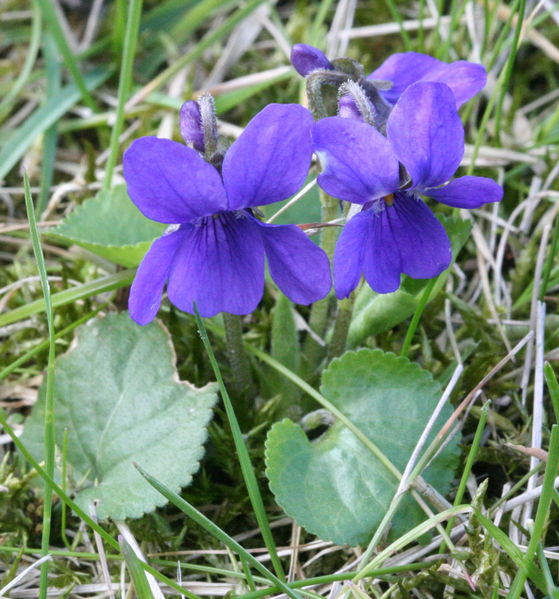
| Morphology: Viola odorata is a perennial, acaulescent, stoloniferous herb growing to a height of 3-15 cm. The rhizome is short, thick, erect or oblique, brownish, robust, densely nodded with numerous roots and slender long stolons produced from nodes. The leaves are basal and the leaf blade is orbicular or reniform to broadly ovate-cordate. The dimension of the leaves is usually 1.5 x 2.5 cm, and leaves gradually grow to 4.5 x 4.5 cm. The leaf surfaces are sparsely puberulous or subglabrous, the base is deeply cordate, margins are crenate and the apex is rounded or acute. The flowers are solitary, large, slender, long stalked, fragrant, puberulous or subglabrous and deep purple in colour with two erect upper petals. The ovary is puberulous and styles are slender and straight at the base. The styles are thickened upward, apically curved and slightly compressed and have a hooked beak as long as the diameter of styles, with a smaller stigma hole at the tip of the beak. The sepals are oblong or oblong-ovate, the base is obtuse or shallowly dentate, the apex is obtuse and the basal auricles are 2-3 mm. The petals are crenate, with obovate upper petals, lateral petals placed inside and shortly bearded and the anterior petal is broadly obovate. The size of the petals is 1.5-2 cm including the spur, which is 2-4 mm long and straight or slightly curved. The spurs of the two anterior stamens are robust. The capsule is globose and densely puberulous. |
| Distinguishing features: The plant can be distinguished by its heart shaped leaves. |
| Life cycle: Flowering takes place in April-May and fruiting takes place from June-September. |
| Uses: The substances present in sweet violet have expectorant and diuretic properties and the plant is used for bronchitis, whooping cough, head colds and urinary infections. It is also a component of diuretic tea mixtures that alleviate rheumatic pain. Externally, sweet violet is included in compresses applied to swelling, slow healing wounds, ulcers and rashes and in mouthwashes or gargles. It is used in ‘vata-kapha’ diseases, hepatic diseases and constipation and pyrexia. It is also used in hypertension, blood related diseases and respiratory disorders. Sweet violet is used as food and the leaves and flowers are edible can be eaten raw. The flowers are also used fresh to flavour and colour confectionery items. The plant has anti-inflammatory, anticancer, demulcent, diaphoretic, diuretic, emetic, emollient, expectorant, homeopathy, laxative and purgative properties. |
|
| |
|
|
 |
|
| Family: Violaceae |
| Common/local name: Wild/sweet violet, English violet, Marsh violet, Nirbishi (Joshimath), Vanafsha (Hindi) |
| Trade name: Sweet Violet |
|
|
|
| File Size:971.21875kb |
|
|


