| |
|
|
| Species: Bergenia stracheyi |
|
|
| Profile: |
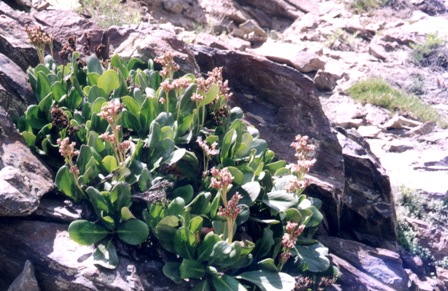
| It is a common resident of shady ravines, rocky edges and moist, well-shaded slopes. This plant may be identified by pink drooping clusters of flowers and large thick leaves with sheathing leaf bases that protect the flowering stalk. Curiously the Sanskrit name, Asmaghana, meaning ‘rock splitter’, corresponds with the meaning of the older Latin generic name ‘Saxifraga’, meaning the same, probably because of its natural habitat. The dark brown or reddish coloured rhizomes of this plant are generally used for medicinal purposes. |
| Habitat and ecology: Bergenia stracheyi is commonly found from Kashmir to Uttarakhand in the altitudinal range of 3300-4500 m. It prefers sheltered, moist, but well-drained sites, where it usually grows in colonies, particularly between boulders, where a long lasting snow cover provides adequate water or on the edge of rivers or ponds. It is often seen on glacial mountains and on moist rocky slopes. |
| Morphology: This is an erect, fleshy, perennial herb, with stout creeping rootstock and a short stem. The leaves are obovate to oblong, having cuneate base and rounded apex. The margins are crenate or dentate, ciliate, glabrous or puberulous. The leaf margin is finely toothed and has bristle like hairs. The scape is usually 10-20 cm long and pink-tinged. The flowers are white or lilac, arranged in terminal loose corymbs. |
| Distinguishing features: Large thick leaves distinguish the plant with leaf stalks sheathing at the base and its stout flowering stem arising from the stout rootstock. |
| Life cycle: Flowering and fruiting of this plant takes place in the months of June-August. |
| Uses: The rhizome is used for the treatment of stones in kidney and also as a poultice for stiff joints. The root powder is considered a diuretic. In the eastern Himalayas it is chewed for curing diarrhoea and controlling vomiting. It is also used against fever, coughs, pulmonary affections and boils. This herb is known to have cooling properties and is therefore used as a tonic to treat fever. It also acts as an astringent and applied for eye ailments and on cuts and wounds. The root powder is used to treat renal and urinary disorders and aids the removal of kidney stones. The rhizome contains tannic acid and gallic acid. In the Garhwal Himalayas, the rhizomes are applied externally as a paste on stiff joints. The leaves, particularly tender ones, are edible and used as a vegetable. The rhizome powder is also used for treating diarrhoea in cattle. |
|
| |
|
|
 |
|
| Family: Saxifragaceae |
| Common/local name: Kongli (Tibet), Dak–kya–hawo, Gatikpa (Spiti), Shilphor (Uttaranchal) |
| Trade name: Pashanbheda |
|
|
|
| File Size:520.802734375kb |
|
|
|
| |
| |
|
|


