| |
|
|
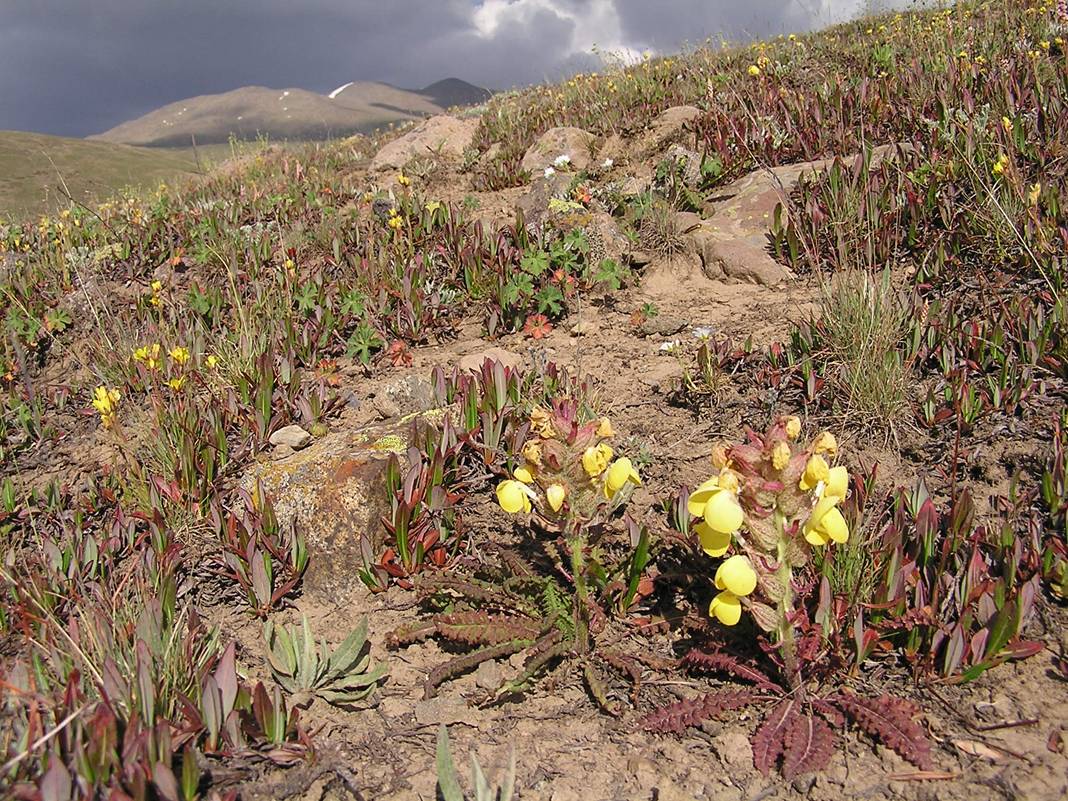
| Species: Pedicularis bicornuta |
|
|
| Profile: |
| The plant derives its name from the Latin word pediculus, which means a louse. In the western Indian Himalayas, the Tibetan women offer the flowers to the deity. The inhabitants consider the plant species to possess some sanctification value and use it in various social customs. The aerial parts of the plant are used for medicine and are edible. |
| Habitat and ecology: The species is found in highly moist areas such as forest grounds, meadows, slopes and near water sources. The herb normally grows between 2700-4400 m from Afghanistan and Pakistan to southwest China and India (common in Kashmir, Himachal Pradesh and the alpine Himalayas). |
| Morphology: The plant is a robust herb with a terminal cylindrical cluster of many large pale yellow flowers. The corolla has a distinctive upper lip which is s-shaped, or spirally curved, with a slender deeply bifid beak. The corolla-tube is hairy and the calyx is inflated and hairy with small irregular lobes. The leaves (15 cm long) are alternate, stalked, linear-oblong and pinnately cut into rounded, toothed or lobed segments. The stems are stout and usually 15-60 cm long. |
| Distinguishing features: It is a robust herb with a terminal cylindrical cluster of usually many large pale spirally curved yellow flowers. |
| Life cycle: This perennial herb completes its seed to seed life cycle in the month of August-September when flowers get dried up and seeds mature. Mature seeds get dispersed with wind and new plantlets come up from April-May when summer begins. |
| Uses: The aerial parts including leaves are cooked as vegetable. The root is used for preparing liquor. The powdered aerial parts are given in a dose of 1 tablespoon a day to cure chest pain, backache and bleeding through the mouth. The locals use the leaf juice on cuts to control bleeding. |
|
| |
|
|
 |
|
| Family: Scrofulariaceae |
| Common/local name: Two-horned louseworts, Tawang: Lhook-roo-karpoh. |
| Trade name: Data not available |
|
|
|
| File Size:444.0556640625kb |
|
|
|
| |
| |
|
|


