| Profile: |
| Jangli Kuth (Arcticum lappa) is a member of the Asteraceae family and is cultivated for its root, which is used as a medicine (in Traditional Chinese medicine) and vegetable (especially in Japan, Korea and Brazil). |
| Habitat and ecology: This species is native to the temperate regions from Scandinavia to the Mediterranean, throughout Europe and in the Middle East to China and Japan, including India. The species occur widely in the western Himalayas, 1800-3800 m. In the Himachal Pradesh the plant is commonly found in the high hill areas of the temperate forests in Chamba, Kullu, Kinnaur and Lahaul and Spiti and in the Zanskar valley of Kargil district in Jammu and Kashmir. The plant is also common in the central Himalayas, in the Tons valley area near Netwar. The plant is hygrophilic and is generally found near to the water bodies. Arctium is also found in the wastelands and along agriculture fields. The species can be easily cultivated in the temperate areas where rainfall is quite well. The plant succeeds in most soils when grown in partial shade. They are best grown in a light well-drained soil and tolerate a pH in the range 4.6-7.8. |
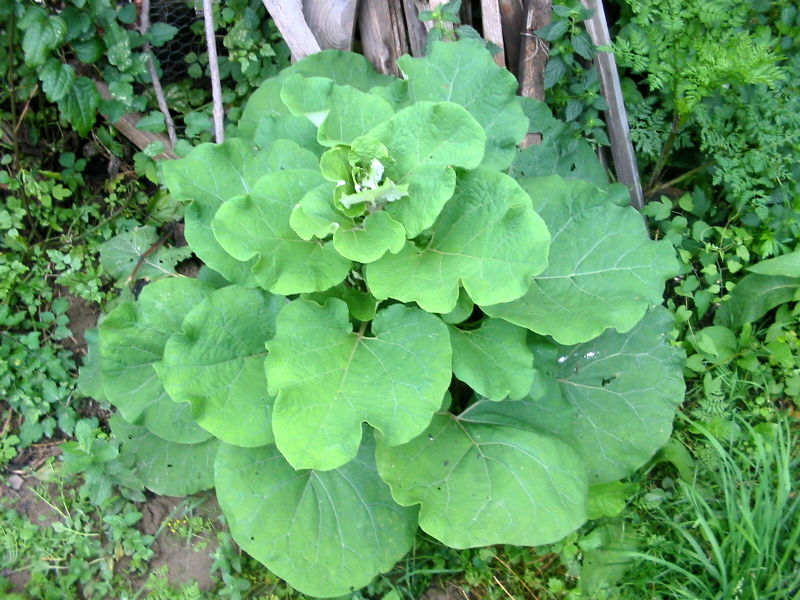
| Morphology: It is an erect, branched herb attaining a height up to 1 m or more. The leaves are about 75-30 cm long, alternate, ovate and chordate with the margins undulated or toothed. The flower heads are globose in terminal clusters, arranged in involucral bracts with rigid awl-like spreading barbed tips. The corolla and the stamens are purple-pink and the style is white. The fruits are large, oblong, ribbed and angled achenes. |
| Distinguishing features: The flowers are purple and grouped in clusters. The capitula are surrounded by an involucre made out of many bracts, each curving to form a hook, allowing them to be carried long distances on the fur of animals. |
| Life cycle: The plant is generally a perennial, but sometimes shows biannual features. Flowering takes place in the months of June-August and fruiting in August-September. |
| Uses: The tender leaves, stalks and roots of Jungli kuth are edible and are a good source of nutrition. The plant has diuretic and arexigenic properties and is used for cutaneous eruptions, rheumatism, cystitis, and gout and specifically for eczema and psoriasis. The plant extract is considered to be cancer preventive and used in some traditional anticancer formulations. The young roots can be eaten raw and have a mild flavour, but older roots are normally cooked as they have a stronger flavour. The seeds can be sprouted and used like bean sprouts. The plant is used as a herb in both Chinese and Western herbal medicine. It is used to treat throat and other infections, boils, rashes and other skin problems. The plant is antibacterial, antifungal, carminative. It is used in the treatment of herpes, eczema, acne, impetigo, ringworm, boils and bites. |
|
| |
|
|
 |
|
| Family: Asteraceae |
| Common/local name: Jangli Kuth, Greater Burdock, Miah (Zanskar), Birzung, Pitsuak, (Western Himalayas), Burdok (Lahaul) |
| Trade name: Jangli Kuth |
|
|
|
| File Size:1224.5068359375kb |
|
|


