| |
|
|
| Species: Arnebia benthamii |
|
|
| Profile: |
| This highly valued Himalayan plant has enormous socio-cultural as well as medicinal significance, almost all parts of the plant being used for medicines, food, dyes and beverages. Arnebia benthamii is also known as Macrotomia benthamii. For use in medicine, it is typically powdered and mixed with other herbs and material for application or ingestion. Arnebia or Ratanjot, as it is commonly known, is not only important medicinally, but also has a very important place in the Himalayan society. The dye ‘shikonin’ is extracted after keeping the roots immersed in mustard oil or ghee for a considerable duration. Unfortunately, unsustainable harvesting from the wild has reduced the wild populations of this species greatly. |
| Habitat and ecology: It grows well on the open slopes and shrubberies, at an elevation between 3300-4500 m in the temperate to alpine Himalayas. The plant species is distributed from Pakistan to Nepal between 3300-4500 m elevation especially in the alpine pasture and slopes. In Kashmir, the species has been reported from Kurram valley, Deosai plains, Pir Panjal, Makra, Kagan valley, Bedori, Aliabad. In Himachal Pradesh the species is found in Thamsarjot of Bara Bhangal in Kangra and Jakha Kanda of Dodrakawar in Shimla district and in the moist areas of the Pin valley, Great Himalayan National Park, Chamba, Kinnaur, Rohtang Pass and Lahaul. In Uttarakhand, the plant occurs in the alpine and sub-alpine slopes of Kumaon and Garhwal, specifically in the locality of Har ki-doon, Himtoli, Dayara, Kedarnath, Neelkanth in Uttarkashi, in Mana, Valley of flowers, Kakbhusand, Gorson, Jelam, Dronagiri, Malari of Chamoli, in Pindari, Sundardhunga, Ralam, Panchachuli and Trisuligarh in Kumaon. |
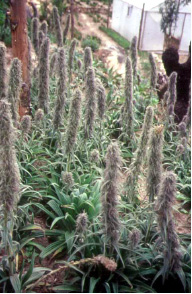
| Morphology: The plant is an erect, robust, herbaceous perennial growing up to a height of 30-90 cm with stout, woody stem and deep red roots. It has a solitary stem, which bears a shaggy-haired spike of reddish-purple flowers that bends downwards like a tail. The leaves are narrow, lanceolate and hairy. The radical leaves are large and cauline. The flowers are crowded in terminal dense spikes and are pale pink purple in dense bending downwards like a tail. |
| Distinguishing features: The roots of the plant are deep red which help in distinguishing the plant. |
| Life cycle: Flowering occurs in the month of July followed by fruiting in the month of August-September. |
| Uses: The root yields a red pigment, which has several medicinal properties and is marketed under the trade name of Ratanjot. The plant is considered an expectorant and is used to cure cardiac disorders. It is also used as a colouring material in hair oils, cookeries and for dyeing silk. Many Ayurvedic formulations are prepared from the plant for the treatment of various diseases of the tongue, throat, fever and cardiac disorders. The roots are also used to cure acute toothaches, ear and eye diseases. The plant facilitates urination and expelling of phlegm, thus helping in remitting chronic cough and cold problems. The species is a major ingredient of the commercial drug available under the name Gaozoban, which is antibacterial, antifungal, and anti-inflammatory and has wound healing properties. The paste obtained from crushing the herb is also used as a poultice in cases of sprains, on burns and swelling of organs. The juice extracted from the plant material is useful for curing diseases of the tongue, throat and in fever. The plant is also used as a food supplement. The flowering shoots are boiled and sherbets, syrups and jams are prepared from the extract. It is used as a hair tonic and the root powder is applied to the hair mixed with hair oil. The red roots yield a vegetable dye, widely used in the Himalayan region since time immemorial, for purposes as varied as dyeing of clothes to colouring of the offerings to deities and pigmenting of other foodstuff. |
|
| |
|
|
 |
|
| Family: Boraginaceae |
| Common/local name: Arnebia, Birnjasif, Millfoil, Yarrow, Sanguinary. |
| Trade name: Ratanjot |
|
|
|
| File Size:330.6884765625kb |
|
|
|
| |
| |
|
|


