| |
|
|
| Species: Arnebia euchroma |
|
|
| Profile: |
| Arnebia euchroma is a highly valued Himalayan plant that has socio-cultural and medicinal significance, with almost all parts of the plant being used for medicines, food, dyes and beverages. The plant is mainly harvested for its roots which are used in medicines and and as a dye. Unfortunately, diminishing wild populations have pushed the plant on to the list of threatened species. |
| Habitat and ecology: It is an erect, caespitose, hairy, perennial herb found commonly in dry patches of the subalpine scrubs of the western Himalayas. The plant prefers dry, sandy soil and grows abundantly on rocky slopes. The plant is frequently found in Lahaul and Spiti of Himachal Pradesh at Kibber, Attagru, Kee Gompa, Rongtong slopes and Burr peak. It is also found in Pooh division of Kinnaur. In the central Himalayas, the herb grows between an altitude of 3300 and 4500 m. |
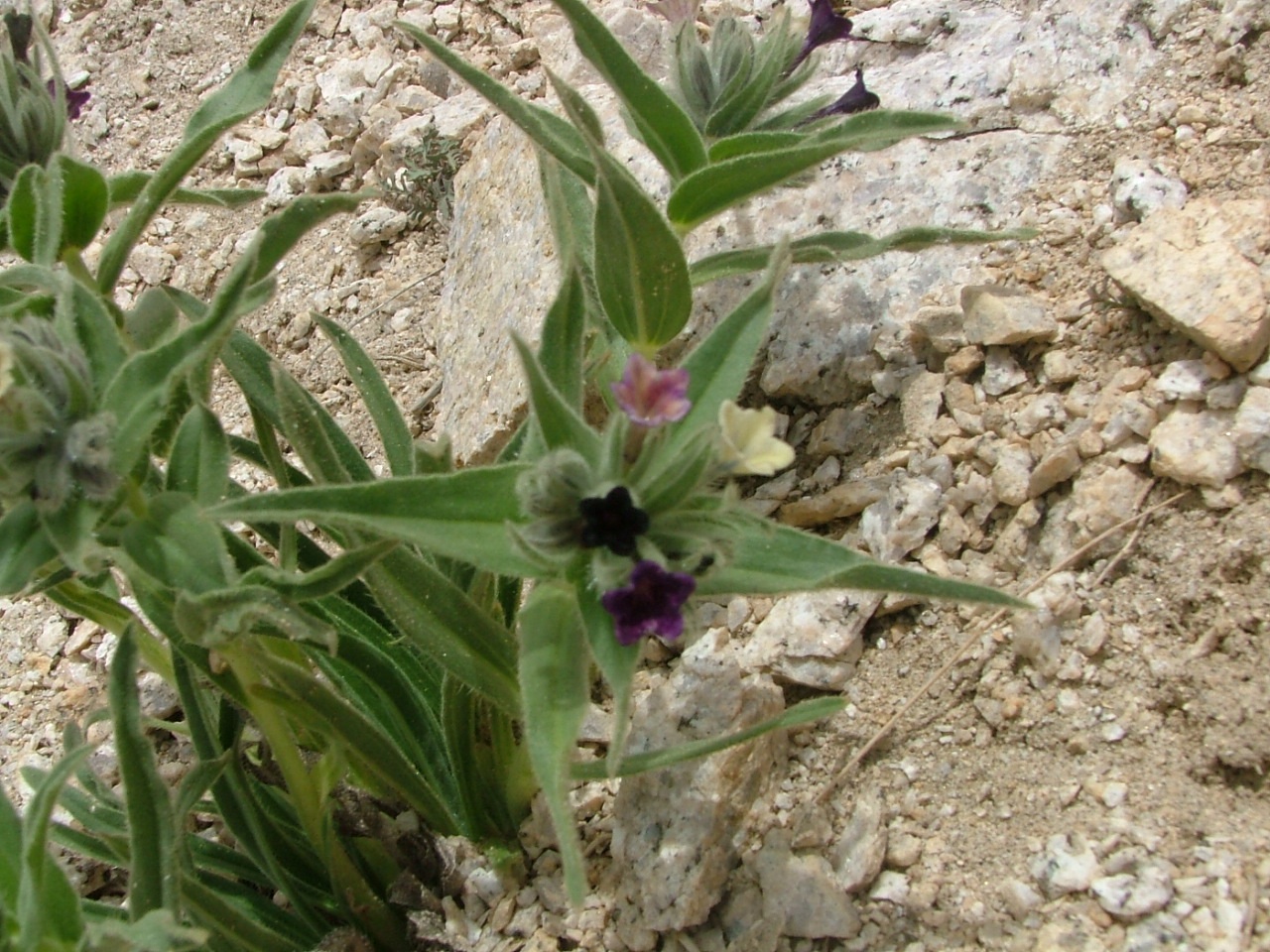
| Morphology: The plant has many pubescent stems that arise from the previous year’s basal cluster. The basal leaves are lanceolate and acute with the lower and middle leaves being cauline and sessile while the upper leaves are short and broad. The flowers are pinkish or purplish in colour and are borne on terminal, subglobular inflorescence. The bract like leaves does not exceed the calyx. The calyx is divided into the base and covers the funnel shaped corolla. The rootstock is purplish and stout. |
| Distinguishing features: The plant can be distinguished from its hirsute shoots and it differs from Arnebia benthamii by its rounded clusters of pale pinkish purple flowers. The other major characteristic feature of the species is the dark purple roots. |
| Life cycle: Arnebia euchroma has a perennial rootstock and the aerial portions are produced from the collar region of the previous year’s growth. Sprouting occurs as soon as the snow melts. Flowering is initiated in the month of July and the process of pollination, fertilization and seed setting continues up to the end of September. The aerial portions start gradually drying from below and the plant remains with the inflorescence containing the physiologically mature seeds till about the end of October. The aerial shoots dry up completely by early November. |
| Uses: The roots are primarily used as a dyeing agent and the extract ‘Ratanjot’ is used for addition in hair tonics. Apart from this the roots are also used to cure toothache, ear and eye diseases. This said to possess anti-microbial and anti-inflammatory properties and is used to heal cuts and burns. For use in medicine, it is typically powdered and mixed with other herbs for external application or ingestion. The plant facilitates urination and expelling of phlegm, thus helping in remitting chronic cough and cold conditions. The paste obtained from crushing the herb is also used as a poultice in cases of sprains and swelling of organs. Juice extracted from the plant material is considered useful for curing diseases of the tongue, throat and fever. The paste of the plant material in water is used on burns and is reported to be a quick healer. The purple roots yield a vegetable dye, widely used in the Himalayan region since time immemorial, for purposes as varied as dyeing of clothes to colouring of the offerings to deities and pigmenting of other foodstuff. The dye ‘shikonin’ is extracted after keeping the roots immersed in mustard oil or ghee for a considerable duration. |
|
| |
|
|
 |
|
| Family: Boraginaceae |
| Common/local name: Ratanjot (Hindi), Khuamed (Bhoti), Demok (Spiti, Zanskar) |
| Trade name: Ratanjot, Khamed, Demok |
|
|
|
| File Size:515.9638671875kb |
|
|
|
| |
| |
|
|


