| Profile: |
|
Artemisia absinthium, like other members of the genus Artemisisa, is poisonous if used in large quantities. The name of the plant comes from apsinthion, which means unenjoyable in Greek and refers to the bitter taste of the leaves. Even small quantities have been known to cause nervous disorders, convulsions, insomnia etc. The plant contains thujone, which acts as a brain stimulant in small quantities but is toxic in excess. The species is harvested as it is coming into flower and then dried for later use. The plant is a drought tolerant species.
|
| Habitat and ecology: This perennial herbaceous plant is found on open slopes and in cultivated areas. This plant is a native of Europe, but is also found in Kashmir. It enjoys semi-dry warm sunny slopes and does not grow well in shady moist places which experience frequent rains. It sometimes even grows to weed proportion. |
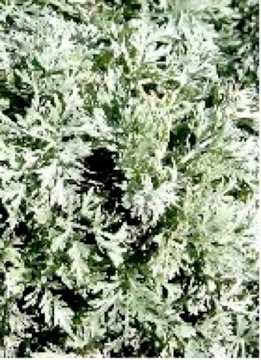
| Morphology: This is a much-branched silvery-haired leafy perennial plant with long, one-sided spike-like lateral clusters of tiny drooping yellowish flower-heads, collectively forming a narrow pyramidal inflorescence. The flower-heads are globular, 3-4 mm in length. The outer involucral bracts are green with woolly hairs and the inner side is papery. The leaves are approximately ovate in outline, 2-3 times cut unevenly into oblong to lanceolate segments which are 2 mm broad, grey or white silvery on both sides. The stems often grow up to 1 m. |
| Distinguishing features: This perennial herb is erect, up to 90 cm tall and has a silvery ribbed stem. The plant parts can be easily distinguished by their peculiar smell when crushed. |
| Life cycle: Flowering occurs in September-December and fruiting occurs from October-February. |
| Uses: A powder is prepared by sundrying the parts of the plant that are above the ground and it is used as an incense by putting a pinch of it in the fire. The plant is used as an anthelmintic, aphrodisiac, antiseptic, tonic and diuretic; and also for chronic fever, dandruff, debility and rheumatism. The whole herb is used as an aromatic tonic. On distillation it yields a dark green or yellow oil, having a strong odour of the plant and acrid taste, which exercises a powerful influence over the nervous system. In large doses it acts as a narcotic poison. The leaves are occasionally used for flavouring. It is valued especially for its tonic effect on the liver, gallbladder and digestive system, and for its vermicidal activity. It is an extremely useful medicine for those with weak and under-active digestion. The plant should be used with caution, in small doses for short-term treatment only, preferably under the supervision of a qualified practitioner. It should not be prescribed for children or pregnant women. |
|
| |
|
|
 |
|
| Family: Asteraceae |
| Common/local name: Bhurse, Vilayatiafsantin, Warmot, Wormwood, Madderwort, Mingwort |
| Trade name: Warmot, Wormwood, Bhurse, Vilayatiafsantin |
|
|
|
| File Size:387.404296875kb |
|
|


