| Profile: |
|
Berberis aristata is a medicinally important, perennial herb of the temperate to alpine regions of Indian Himalayas. Since ancient times, this shrub has been usedin traditional medicine and also finds mention in the ‘Dhanvantarinighantu’ as having medicinal properties. This species has become threatened due to the unsustainable extraction from forests for trade.
|
|
Habitat and ecology: The plant is distributed in the Himalayas at an altitudinal range of 2,000-3,000 m. It is also found in Nilgiri hills of south India and in Sri Lanka.
|
|
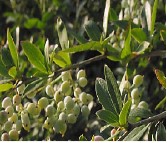
Morphology: It is a large, thorny, deciduous, 2-5 m tall shrub with a furrowed bark. The leaves are stalked, obovate to elliptic, branched, spiny, and leathery and have toothed margins. The flowers are yellow in colour and borne in a compound raceme. The fruits are ovoid, greyish-white when young and bluish-purple when ripe.
|
|
Distinguishing features: The plant is an erect, spiny shrub of 2-3 m height with yellow to brown bark and stalked, yellow hermaphrodite flowers borne in compound raceme. The fruits are globose to ovoid and blue in colour.
|
| Life cycle: Flowering occurs from March-April. The fruits ripen from May-June and the seeds ripen from September-October. |
|
Uses: The plant finds its use in traditional systems of medicine. It is used in spleen troubles, and as a tonic, febrifuge and intestinal astringent. It is an effective remedy for cough, throat and chest troubles. It is also useful in eyesores, eye itching, piles, menorrhagia, chronic diarrhoea and peptic ulcers. Extracts prepared from the stem or roots have been traditionally used for skin diseases, sores and leprosy and as an antidote for poisoning. A decoction made from the plant is effective in jaundice. The fruits of the plant are given as a cooling laxative to children. Berberine, universally present in rhizomes of Berberis spp. has marked antibacterial effects. It is used orally in the treatment of various enteric infections, especially bacterial dysentery and also has anti-tumour properties. Berberine produced from the plant has a stimulating action on the gastro-intestinal tract although the cardio-vascular system is depressed by the action of the compound. It is also an excellent medication in the case of sun-blindness. The bark of its root is a valuable medicine in intermittent and remittent fevers. Apart from the medicinal uses, the root bark yields a yellow dye, whereas the villagers in the hills use the roots for making an alcoholic drink.
|
|
| |
|
|
 |
|
| Family: Berberidaceae |
| Common/local name: Indian Berberry, Tree turmeric, Darhaldi (Bengal), Kashmoi (Garhwal), Rasont, Kashmal (Himachal Pradesh), Chitra, Chutro (Nepal), Chitra, Kasmal, |
| Trade name: Indian Berberry |
|
|
|
| File Size:246.6591796875kb |
|
|


