| Profile: |
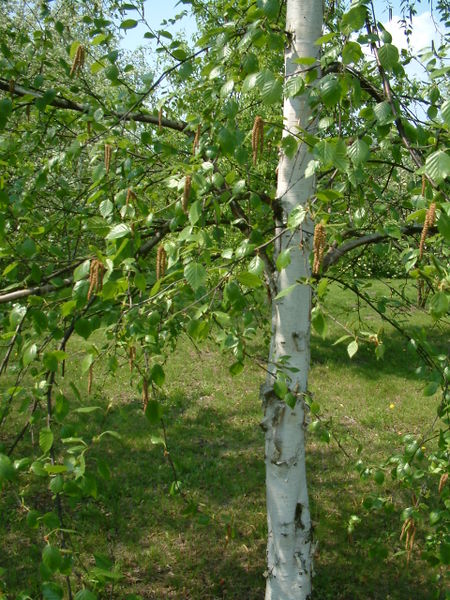
| All the members of the Betula species are distinguished by a membranous outer bark that peels off readily in paper-like strips. In fact, an old Sanskrit word, Bhurja, from which the name birch may have been derived, means ‘that which is written upon’. The distinctive charm of the white birch is reflected with its silvery white bark, its ovate, serrated leaves which are fuzzy on the underside and catkins, which dangle from its branches. Known as Bhojpatra or Bhurja, the birch-bark provided the people of India with their writing material until the 18th century. All ancient manuscripts in India were written on birch bark. Such a bark-book was called puthi or pustaka. Betula wood is used to make agricultural and household implements like ploughs for the fields. |
| Habitat and ecology: In eastern Asia, it is found from the Himalayas to south-western China. It is rarely found below 3000 m. The tree forms the forests of the upper limits of the tree line in the altitude range 2900-3900 m in the temperate Himalayas. It is usually found occurring on the borders of lakes and streams. |
| Morphology: It is a small deciduous tree or shrub, with white bark and conspicuous long horizontal lenticels. The inner layers are pink and peel off in large papery layers while the twigs are dotted with yellow resinous drops. The young shoots and leaves are silky. The leaves are 5-10 cm long, ovate, acute, sharply serrate and the base is broadly cuneate or rounded, rarely sub-cordate. |
| Distinguishing features: The bark of the plant gets peeled off easily from the main trunk in conspicuous layers. |
| Life cycle: Betula utilis flowers in the months of May-June and fruits set in the form of nutlets in late July-August. |
| Uses: A decoction of the bark is used as a wash in ottorhoea and on wounds. The infusion of the bark is used as a carminative and is also prescribed in hysteria. Besides this, the plant is known to have certain aromatic and antiseptic properties. In Malaysia, bark is used in the form of decoction for jaundice and bilious fevers, however not an antidote to snake venom. The bark is used for lighting fires and in religious ceremonies. It is also used traditionally to treat redness of the eyes by burning a piece of it before the eyes of a patient in the morning and quickly extinguishing it in water contained in a bronze vessel. The twigs are used as a broom to sweep verandas and cow sheds. In India, the tree is utilized for its antiseptic, aromatic, carminative and contraceptive properties. In Ayurveda, the bark is acrid, pungent, tonic, alexiteric, useful in convulsions, bronchitis, diseases of the blood and the ears. In Unani medicine, the bark is used for earaches. |
|
| |
|
|
 |
|
| Family: Betulaceae |
| Common/local name: Bhojpatra, Bhujpatra (Uttaranchal), Chattrapatra, Bindupatra, Vidyadata, shag (Spiti) etc. |
| Trade name: Bhojpatra, bhurjapatra |
|
|
|
| File Size:880.048828125kb |
|
|


