| |
|
|
| Species: Bistorta affinis |
|
|
| Profile: |
| Bistorta affinis belongs to the family Polygonaceae and is a common alpine and sub-alpine species. The plant is distributed along the high altitude regions of the Himalayas. The roots of the plant are used in traditional medicine. |
| Habitat and ecology: It is a mat-forming herb, which is a common alpine and sub-alpine species. It is found in the altitudinal range of 3,000-4,800 m. It is found in open slopes, screes, edges and rocky places. It is distributed in Pakistan, India, Nepal and West Myanmar. In India, it is found in Himachal Pradesh, Jammu and Kashmir, Sikkim and Uttar Pradesh. |
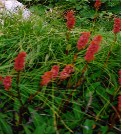
| Morphology: Bistorta affinis is a low, creeping, densely tufted and mat-forming, alpine plant with narrow, elliptic leaves that are glaucous beneath. It has many cylindrical spikes and pale or deep pink flowers that are borne at the ends of short erect stems. The leaves are mostly basal, 3-8 cm and attached to a short stalk. There are several flowering stems, 5-25 cm long with few small leaves. The rootstock is woody and branched. |
| Distinguishing features: The plant can be distinguished by creeping stem with a cushion like spread and cylindrical spikes of deep pink flowers. |
| Life cycle: Flowering and fruiting occurs from June-September. |
| Uses: The plant has several medicinal values. In Tibetan medicine, it is used as an anti-inflammatory and anti-pyretic drug. In Nepal, the plant is used to treat cough, cold, tonsillitis and fever. The flowers are used to treat abdominal and back pain. It is helpful in lung disorders associated with fever and flue. The plant also shows anti-inflammatory properties. |
|
| |
|
|
 |
|
| Family: Polygonaceae |
| Common/local name: Masloon, Chookroo, Himalayan fleece flower |
| Trade name: Not available |
|
|
|
| File Size:225.6328125kb |
|
|
|
| |
| |
|
|


