| |
|
|
|
| Profile: |
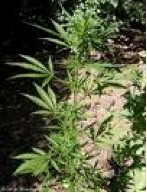
| This plant is found growing at an elevation of 3300 m and is cultivated commercially in the Garhwal and Kumaon region of Uttarakhand in places like Almora and Nainital. The plant is distinguished by its strong characteristic smell. It is an erect plant with finger-like leaves and a slender, grooved stem, covered with long, soft, wool-like hairs. The creamy-yellow coloured flowers grow in clusters. The leaves and flowering/fruiting tops of the female plant possess narcotic properties and are used as a medicine in very low doses. The resin extracted from the flowers and leaves forms an ingredient for many traditional Ayurvedic preparations like ‘Vijaya vatika’, ‘Kameswar modak’, and ‘Vedanantak rasa’. Bhang or siddhi, ganja and charas are the different forms of narcotics obtained from this plant. A special drink is prepared from these, which is enjoyed by the local communities during particular festivals. |
| Habitat and ecology: Cannabis sativa is indigenous to the Western and Central Himalayas, growing at an elevation of 3300 m. It is widely cultivated in both temperate and the tropical parts of the Indian subcontinent and is also found as a weed in wastelands and open areas. |
| Morphology: It is a tall annual herb growing up to a height of five meters. The stem is slender, grooved, finely tomentose. The leaves are long stalked, 5-20 cm long, alternate, palmately divided into 7-11 leaflets, toothed and pale downy from beneath. The plant is dioecious, with male flowers clustered in drooping panicles, while the female flowers are sessile and erect. The achene is small, rounded, dark grey in colour. The upper leaves have 1-5 linear, lanceolate, long and pointed leaflets. |
| Distinguishing features: It is distinguished by its strong characteristic smell. The plant is an erect annual with digitate leaves. |
| Life cycle: The plant flowers in June and fruiting occurs in October. |
Uses: Cannabis sativa is used as a narcotic, sedative and analgesic. It has psychotropic properties. At present, it is rarely used as a drug. The plant yields a semi-drying oil which is used as an illuminant in paints, varnishes and soaps. The dried stem yields a useful fibre which is used for making ropes, shoes and handbags. The leaf juice is used to remove lice and dandruff and leaf powder is used for dressing wounds. The seeds are roasted and eaten by the hill people. The seeds and leaves are also said to be useful in treating cancers and scirrhous tumours. The seed paste is a folk remedy for cancerous ulcers while the decoction of the root is a remedy for hard tumours and knots in the joints.
|
|
| |
|
|
 |
|
| Family: Cannabinaceae |
| Common/local name: Indian Hemp, Ganja |
| Trade name: Hashish, Vijaya, Bhangolu, Bhang, Charas |
|
|
|
| File Size:275.4208984375kb |
|
|
|
| |
| |
|
|


