| Profile: |
|
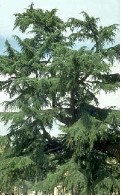
Cedrus deodara is a large confierous tress native to the western Himalayas. The name deodar means ‘wood of the gods’ and comes from the Sankrit language (dev = god + daru = wood). The tree is considered holy across northern india and its wood and needles are used in religious ceremonies. It is also widely grown as an ornamental tree for its grand structure and drooping foliage. Various oils are also extracted from the tree, each with a characteristic woody odour.
|
| Habitat and ecology: It is found throughout Western and Central Indian Himalayas at elevations ranging from 1200-3300 m. It is most commonly found in the altitudinal range of 1800-3000 m. In India, deodar forests are common from Kashmir to Garhwal and form the bulk of the vegetation in these regions. It is distributed in most parts of Himachal Pradesh and Uttaranchal between 2200-2800 m. |
| Morphology: It is a large evergreen tree, often reaching 90 m in height with the girth being 10-12 m in very old trees. The branches arise irregularly and can be horizontal or slightly ascending or descending. The leaves are either solitary or in dense clusters, dark green to bluish green, rigid, leathery, 3-sided, sharp, pointed and 2.5-4 cm long. It is a monoecious plant, although male and female cones appear on separate branches. Dioecious trees are very rare. The female cones are barrel-shaped, large, erect 10-13 cm by 8-10 cm with numerous thin scales and borne singly at the tip of the dwarf shoots. Male cones are cylindrical 5-12 cm, erect, solitary at the end of the dwarf shoots. They are cylindrical and 2.5-4.5 cm in length. The seeds are triangular with a broad wing. |
| Distinguishing features: The tree has characteristic shining, silvery-green and sharply pointed leaves on long branches, rising irregularly from the trunk. |
| Life cycle: Flowering and fruiting takes place in the month of September-November. |
| Uses: All parts of the tree are used in extracting oil which is used in inflammations, dyspepsia, insomnia, hiccups, fever, uro-genital infections, bronchitis, itching, elephantiasis, tuberculous glands, leucoderma, ophthalmia, piles, mental disorders, diseases of the skin and blood. In goats, a disease called “Makku” can be cured by applying deodar oil all over the body of the animal. In ancient times, the oil was used for curing skin complaints including mange in horses. In a 20% concentration made in castor oil, it produced 100% curative effect against sarcoptic mange in buffalo-calves. It is also effective against sarcoptic mange in dogs, sheep, goats and camels. Deodar wood is highly valued as timber and is used for construction of houses and temples and for making furniture, boats etc. The dry branches are used as fuel wood. The smoke of deodar is considered holy and so its wood is burnt in every religious occasion. The oil finds use in a range of fragrance applications such as soap perfumes, household sprays, floor polishes and insecticides. The oil is also used in small quantities to clean microscopes. In India, Cedrus deodara oil has been shown to possess insecticidal and antifungal properties and is used to control fungal diseases in spices during storage. |
|
| |
|
|
 |
|
| Family: Pinaceae |
| Common/local name: Cedar wood, Deodar cedar, Himalayan cedar, Devadaru (Sanskrit and Bengali), Deodar (Hindi), Devadaari (Tamil) |
| Trade name: Cedrus wood |
|
|
|
| File Size:370.697265625kb |
|
|


