Himalayan VOICES High Himalaya FORUM Himalayan Heritage  
 
Search
 
 
View more Databases:
CULTURAL RESOURCES
Tribes
Socio-economic Fabric
Language & Literature
Art, Crafts & Architecture
 
Species:        Dactylorhiza hatagirea
Profile:

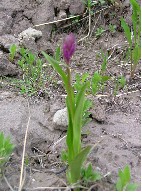
This herbaceous orchid has fleshy, tuberous roots with 5 tubers, which interestingly, resemble the open palm of a person. This is the reason for its name in Hindi “salampanja” which refers to a palm. The vibrant pink spikes of flowers abloom in the green alpine meadows during the months of June and July present a picturesque sight. The roots of the plant are important medicinally and are collected in the months of September-October, by uprooting the plant, which unfortunately is a destructive way of harvesting.

Habitat and ecology:   Salampanja or Panja as this plant is commonly known is one of the significant plants endemic to the temperate Western Himalayas, typically found in the altitude range 2800-4200 m. Its range falls in Pakistan, India and Nepal and is found in well-watered grassy meadows and on slopes.
Morphology:   It is a glabrous, terrestrial and robust orchid growing up to a height of 30-90 cm. The roots are tuberous, slightly flattened and divided into 2-4 fingers like processes. The flowering stem is erect, hollow, leafy throughout or with the lower portion bearing a few sheathing scales. The leaves are oblong or oblong-lanceolate. The flowers are spotted, rosy-purple, arranged in a many-flowered dense cylindrical terminal spike, borne on the robust leafy stem. The sepals and petals are nearly equal, three coming together in a hood with the two lateral sepals are spreading. The edges are rounded, shallowly three-lobed and spotted dark purple. The bracts are acuminate and much longer than the flowers.
Distinguishing features:   The flowers are predominantly pink or purple with a spur. Most characteristic feature is that the tubers are divided into two to three finger-like processes (palmately lobed).
Life cycle:   Flowering takes place in the months of June-July and fruiting takes place in autumn during the months of September-October.
Uses:  The roots are farinaceous, used as a nervine tonic and an aphrodisiac. The mucilage jelly is nutritious and useful in diarrhoea, dysentery and chronic fevers. In the Unani system of medicine, it is used in seminal debility, chronic diarrhoea and general weakness in debilitated women after delivery. It is also considered as a demulcent, nutritive, astringent and is given to a person affected by paralysis. This nutritive tonic is also used against chronic diarrhoea and to address the general weakness suffered after any major illness. This is an invaluable medicine for the restoration of vigour and is conventionally taken by those undertaking hard labour. The usual recipe is to mix the powdered rhizomes of 1-2 plants with honey or ‘ghee’ (clarified butter) and consume it with cow’s milk once a day.

 
Family: Orchidaceae
Common/local name: Salep Orchid, Hathajari, (Uttaranchal), Angbulakpa (Spiti), Salampanja, Panja (Lahaul)
Trade name:
File Size:249.9287109375kb
Download