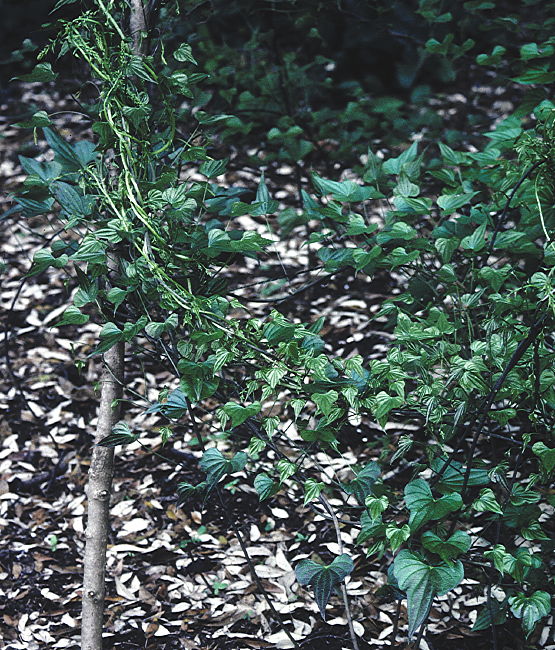
The plant is cultivated for its edible root in India. It is a climber that supports itself by twining around the branches of other plants. The plant can be propagated through its seeds, tubercles or basal stem cuttings.
Habitat and ecology: The plant occurs in the Northwestern Himalayas from Kashmir and Punjab to Nepal and China. The plant grows at an altitudinal range of 2700-4300 m on rocks or open slopes. It grows in light (sandy), medium and heavy soils and requires well-drained soil. It can grow in semi-shade or no shade and requires moist soil. Due to over exploitation, its population in the wild is decreasing alarmingly.
Morphology: The flowers are dioecious. Individual flowers are either male or female, but only one sex is to be found on any one plant so both male and female plants must be grown, if seed is required. It is a glabrous, twining herb, with tuberous roots. The leaves are alternate, long petioled and usually ovate-lanceolate with long, pointed, widely chordate, rounded and projecting basal lobes. The spikes are solitary and the capsule is broadly winged. It is an extensive rhizomatic climber with stems twining to the left. The rhizomes are horizontal, grayish brown with rigid scattered roots on them. The fruits are three winged.
Distinguishing features: This is an extensive climber with stems twinning to the left. The leaves are stalked, cordate, acute and often triangular. The fruits are triangular, membranous and resembles the nosering worn by ladies in the hills.
Life cycle: Flowering occurs in May and fruiting occurs in July.
Uses: It is an important plant for the pharmaceutical industry. The plant is used mainly as a source of steroidal hormones and is used in the preparation of injections and tablets for use in modern medicines like birth control pills. It is also used to treat rheumatic pains, allergies and certain ophthalmic disorders. The edible species of Dioscorea have opposite leaves while the poisonous species have alternate leaves. The tuber has a slightly bitter flavour when cooked. The juice of the root tuber is taken in the evening as a treatment for roundworms. It is also used to alleviate constipation. Soap is also obtained from the tuber, which is used as a body wash to kill lice.