|
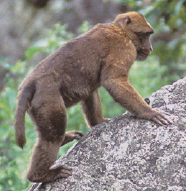
Macaca munzala is a new species of primates from the forests of western Arunachal Pradesh. It was discovered by scientists in 2003 and reported as a new species in 2005, more than a century after the last species of primates was discovered. However, the locals were aware of the existence of this species for quite sometime. In fact, the species name is derived from its local name “mun zala” in the dialect of the Dirang Monpa tribe of Arunachal Pradesh, which means ‘deep forest monkey’. The species, believed to be a close cousin of the Assamese macaque and the Tibetan macaque, is generally large and heavy-set and has a characteristic short tail, the length of which is intermediate between that of the Assamese macaque and the Tibetan macaque. The body varies from dark brown to chocolate brown, while the upper torso and hands and feet are pale brown. The animal is covered with long, dense hair on the upper body while the lower body has shorter, smoother hair. At the front of the crown, every individual has a prominent pale-yellow patch with a group of dark hairs in the centre. It has a lower projecting jaw and the upper part of the head is broader than the muzzle, especially in adult males. The face is dark brown with a prominent dark patch on each temple. The skin around the eyes is pale, giving the animal a spectacled appearance. In several individuals, the nose is of a lighter colour. In contrast to other macaques, the side-whiskers and beard are not prominently developed in this species. Although the local population, which is predominantly Buddhist, does not eat primates, they often kill them in retaliation against damage inflicted to their crops by these animals.
|