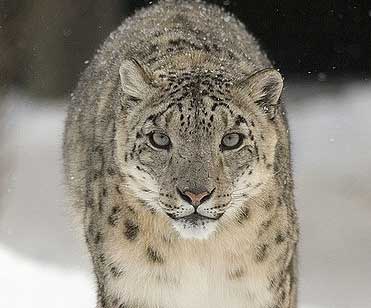
The snow leopard is the sole member of the genus Uncia. The animal has long and woolly fur, which is predominantly grey with brownish to yellowish tinges on the flanks, and lighter, often white on the belly, chest and chin. The round head with the small ears and distinctive heavy brow is comparatively small for its body size. The animal is about 1.3 m in length. The males (40-50 kg) are slightly heavier than the females (30-40 kg). The long tail (can measure up to 900 cm) helps the cat balance as it moves over rugged and often snowy terrain. The powerful limbs of the snow leopard are relatively short for its body. The fibro-elastic tissue that forms part of the vocal apparatus is under-developed in the snow leopard. Thus, the animal cannot give a full, deep roar. The snow leopard stands at the highest position in the cold desert food chain and the existence of this species is of prime importance in the maintenance of the fragile ecosystem.
Lifespan: 15-18 years
Distribution: Snow leopards inhabit the mountains of Central Asia in the countries like Afghanistan, Pakistan, India (in the high altitude regions of Jammu and Kashmir, Himachal Pradesh, Uttarakhand and Sikkim), Nepal (along the north east frontier especially in Humla and Mustang districts), Bhutan, China, Mongolia, Kazakhstan, Kyrgyzstan Republic, Russia, Tajikistan and Uzbekistan. Although the total area of its range is extremely large, the actual areas where the animal exists are relatively small and fragmented. The snow leopard is a seasonal migrant, following its migrating prey down below the tree line in winter.
Population: 4080-6590 individuals (IUCN) (Figures are for wild population only)
Behaviour: The snow leopard is a solitary creature, except during the breeding season and when the female is raising her cubs. Although popularly considered nocturnal, the animal seems most active in the early morning and late afternoon. The animal prefers steep terrains with rocky caverns, cliffs and crevices. The animal is difficult to spot due to its camouflage patterned body and elusive nature. The animal is an opportunistic predator and can bring down prey up to three times its size.
Diet: The main prey of the snow leopard is wild sheep and goats such as bharal, argali, markhor and ibex, as well as marmots, hare, wildfowl and domestic livestock.
Reproduction: Breeding season: January-March; Gestation period: 98-103 days; Litter size: 1-4; Weaning: 2 months; Sexual maturity: females: 2-3 years, males: 4 years.
Current status:
Status: 1. IUCN 2008: Endangered
2. CITES 2008: Listed In Appendix I
Threats: 1. Prey base depletion
2. Poaching for illegal trade in hides and bones
3. Conflict with local people
4. Habitat degradation and fragmentation
5. Lack of conservation capacity, policy and awareness
Conservation practices: 1. It is protected from hunting by the national legislation across most of its range, except in Afghanistan.
2. The Snow Leopard Network (SLN) was formed in 2008 to unite individuals and organizations such as the International Snow Leopard Trust, the Snow Leopard Conservancy etc.
3. Four countries such as Mongolia, Pakistan, Nepal and Russia have national action plans for the protection of snow leopards.
4. In India, it is listed as a Schedule I species under the Wildlife (Protection) Act of 1972.
5. India has developed Project Snow Leopard, a national governmental program for snow leopard conservation. However, the project lacks adequate funding.
Common name:
Snow leopard
Local name:
Saah, Shan, Tsabo (Jammu and Kashmir), Barhal he (Pahari), Barfani cheetah (Urdu), Burhel haye (Bhotiya), Sheen-e-suh (Kashmiri)