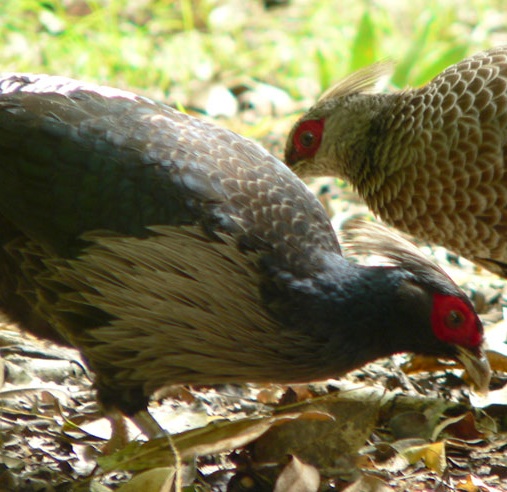
The Khalij pheasant is a ground-dwelling, swift-running game bird found all along the Himalayan foothills. It resembles the village hen to a great extent. Nine subspecies have been identified distributed in various ranges. These include the white-crested khalij (L. l. hamiltoni) found in western Himalayas up to extreme west Nepal, Nepal khalij (L. l. leucomelanos) endemic to Nepal, black-backed khalij (L. l. melanota) found in northwest India and western Bhutan, black khalij (L. l. moffitti) believed to inhabit central Bhutan, black-breasted or Horsfield’s khalij (L. l. lathami) in eastern Bhutan and northeastern India, William’s khalij (L. l. williamsi) in western Myanmar, Oates’ khalij (L. l. oatesi) in southern Myanmar, lineated khalij (L. l. lineata) in eastern Myanmar and northwestern Thailand, and Crawfurd’s Khalij (L. l. crawfurdi) in southeastern Myanmar and southwestern Thailand. There is considerable variation in physical appearance between the different subspecies.
Among all the subspecies that are kept in captivity, the white-crested khalij is most common and are distinguished by a light coloured crest. The males and the females are physically different with the males (65-73 cm long) slightly larger than the females (50-60 cm long). The males have a long thin crest of white or pale grayish-brown feathers, purplish black head and neck and a glossy bluish-black mantle. The rump has bold white bars running across it. The black tail with brown tips is slightly longer than the wings, compressed and “roof-shaped”. The wings are rounded and around 225-250 mm. The primaries and secondaries are blackish-brown, the bill is greenish white and tinged with black at the base, and the legs are pale brown to grey. The females are pale brown in colour with darker and lighter spots. They have a shorter tail and more erect crest than the males. Their crest is dull brown with pale shafts. The wingspan is 203-215 mm. One of the characteristic features of this species is the blood red facial skin around the eyes in both males and females.
Lifespan: Unknown in the wild. Studies on the introduced population of Hawaii suggest that it has a long lifespan.
Distribution: The khalij pheasant has a large range with an estimated global extent of occurrence of 1,000,000-10,000,000 km² (IUCN). It is a resident of the Himalayan foothills of Bangladesh, India, Bhutan, Nepal, Pakistan, China, Myanmar and Thailand. The species is found in the dense undergrowths of evergreen forests and also near agricultural lands and water bodies. Some birds, in particular the Nepal Khalij, have been introduced into Hawaii. The white-crested khalij pheasant is found in the western Himalayas from Pakistan in the west to Bangladesh in the east. It ranges between elevations of 360-3350 m, but most commonly between 900-2200 m.
Population: Not quantified, but believed to be large (IUCN).
Behaviour: The khalij pheasant is more active in the mornings and evenings, and rests during the mid-day. The male call is a loud whistling chuckle with drumming of wings on the body. It utters a crowing call with pig-like squeals during courtship. The pheasant nest is shallow in nature, made up of leaves and twigs. The eggs are pale creamy in appearance and are incubated only by the female. The male takes no part in protecting the nest, but may rejoin the family once the chicks hatch. Chicks can fly within a few days; adult plumage is gained at the end of one year from hatching and by that time the birds are ready for breeding.
Diet: Khalij pheasants are the natural scavengers in forests, feeding on the litter and the droppings of other birds and animals. The bird is omnivorous is nature. Its diet constitutes both vegetarian and non-vegetarian components including insects, worms, larvae, grass, herbs, seeds, berries, shrubs and roots.
Reproduction: Breeding season: February-October; Incubation Period: 20-22 days; Clutch Size: 6-9 eggs; Fledging period: Few days; Sexual Maturity: 1 year
Current status:
Status: 1.IUCN 2008: Least Concern
2.CITES 2008: Not listed
Threats: 1.Habitat loss
2.Hunting for meat by locals
3.Locals use the bird as bait for capturing large animals from the forest
4.Inbreeding between the different subspecies
Conservation practices: The khalij pheasant is easy to breed in captivity. This makes it easy to conserve and stabilize this population.
Common name:
White-crested Khalij Pheasant
Local name:
Khalij (Hindi)
Classification:
Kingdom: Animalia
Phylum: Chordata
Class: Aves
Order: Galliformes
Family: Phasianidae
Genus: Lophura
Species: leucomelanos
Subspecies: L. l. hamiltoni