| Profile: |
| Angelica glauca belongs to the Umbelliferae (Apiaceae) family. All members of this genus contain furocoumarins, which increase skin sensitivity to sunlight and may cause dermatitis. The species is endemic to the Himalayas and its status is endangered due to overharvesting. |
| Habitat and ecology: Angelica prefers rich organic soil. The plant is a partial shade bearer and is found growing in moist patches on hill slopes, especially in the shade of broad-leaved mixed spruce forests. Angelica glauca is naturally distributed in the entire Hindukush Himalayas including Afghanistan, Pakistan and northwest to eastern Himalayas at an altitudinal range of 1800-3700 m. In Uttarakhand the species grows naturally in Ram Valley, Niti Valley, Bandarpunch, Dwali, Phurkiya, Yamunotri, Dronagiri, Hemkund, Bampa and Mana villages in Chamoli. It is also available in Reha forests, Wangtu, Bashahr area, Kagan Valley, Sungri, Shimla, Pulga, Naumor, Dohra, Oonch, Solang Nala, Dhauladhar Range, Hattu, Narkanda, Kalatop, Luwyaine, Lohardi forests, Mariarha forest, Panju, Jaldayan thatch and Dhola-Bagi (Rohru) of Himachal Pradesh and in Jammu and Kashmir. |
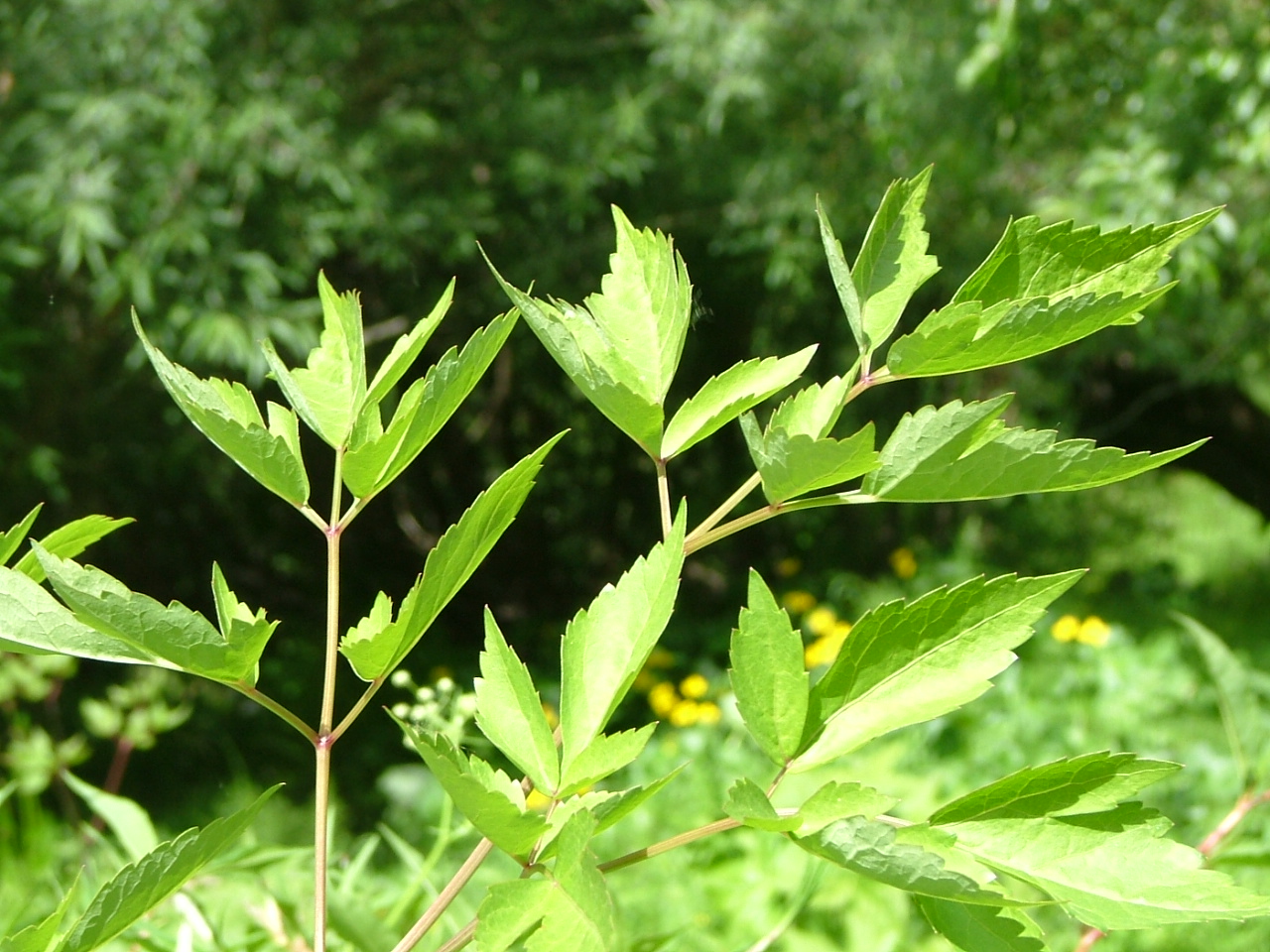
| Morphology: Chora is a tall, erect perennial glabrous herb that grows to a height of about 1-1.5 m. The leaves are pinnately divided. The leaflets are dark green above and shiny below, slightly oval, serrate and mucronate. The flowers are present in large stalked, highly branched umbels and are mostly whitish in colour. The fruits are glabrous and flattened. The plant has very well developed, thick and highly aromatic, brownish roots, which increase in size and thickness with age. |
| Distinguishing features: The plant can be identified by its pungent smell, very characteristic of the species. Another distinguishing feature is the sheaths at the base of the upper leaves encircling the umbels. |
| Life cycle: Being a perennial in the very high altitudes, the plant shows the classical subalpine growth cycle. The winter dormant roots produce new sprouts with the melting of snow and the onset of spring. The plant exhibits a very vigorous vegetative growth for a period of 3 months and moves into the reproductive phase by mid-July. Seed setting is completed by the end of September. After the completion of the natural dispersion of the seeds by wind, the shoot portions dry up and the root portions go dormant again before snowfall. |
| Uses: The roots have been used traditionally as a laxative and in cases of flatulence. It is also used in the culinary delights of the Himalayan villages as a spice for flavoring food. The roots are stimulant, carminative, diaphoretic and diuretic. It is also used in the preparation of bitter liquors. The plant is used as a cordial stimulant in the treatment of dyspepsia and constipation. The root is aromatic and is used for food flavoring. |
|
| |
|
|
 |
|
| Family: Umbelliferae (Apiaceae) |
| Common/local name: Angelica, Chora, choraka (Hindi), Chura (Lahaul), Chamchora. |
| Trade name: Chora |
|
|
|
| File Size:451.626953125kb |
|
|


