It is one of the realities of the Himalayas, that while being considered as the ‘third pole’ in terms of fresh water source for the large populations in the plains and the start of the 10 major river systems of Asia, the people in the hills are themselves unable to access their required water needs with a reasonable effort. Much of the drudgery faced by women in the hills involves ever-lengthening trudges to collect water for their daily household needs. The impact on agricultural activities is even more pronounced with the changing precipitation patterns in terms of frequency, intensity and seasonality; reduced ground water recharge impacting spring flows; change of cropping patterns requiring greater amounts of water; the gradual replacement of traditional, low yielding but resilient species for more standardised but high input species. Add to this the load of the tourism industry, with the attendant influx of a large number of persons during the lean summer months and the picture that emerges is not too encouraging. Understanding the impacts of climate change and glacier movements are an area of additional concern and severely impacted by lack of hard data; though it is generally accepted that the impact in the Himalayas is likely to be many times the impact in the plains.
This need for water has been known for some time now and various piecemeal efforts are being made in various pockets to provide meaningful, low cost and appropriate solutions at the local village and micro watershed level by various interested and concerned individuals and groups. Quite a bit of work is also being carried out at various research institutes that have been mandated with this task though the outreach and ‘lab to field’ effort requires strengthening. These solutions are to be understood in terms of the relative heights of the habitations vis-à-vis the source of water. Broadly speaking we have three types of habitation; first, above the water source, where the stream or river is well below the village level and lifting of water is required; second, below the water source, typically channels using gravity are used to transport water; and third, and technically the easiest, is where the two are at the same level and not much effort is needed to access water. The other issue at the habitat level is where the total water availability is adequate but the timing [seasonality] is of concern, and much water is wasted as more flows occur when not needed and not enough is available at other times. It is to tackle such situations that various storage options need to be considered. Added to this is the changing life styles and attendant changes in water use patterns. Even a change from dry toilets to wet toilets and basic efforts to improve hygiene and sanitation standards increases the demand for water and quality of water starts to occupy increasing importance in the scheme of things. A few of the technologies and adaptation efforts are given below.
Artificial glaciers
Pioneered in Ladakh by Norphel, the artificial glacier innovator, this is a method to store water from snow and protect the water mass from early thawing with the onset of spring so that water is available later in the season when required for irrigation. This method has found acceptance and is gradually spreading in the Western Himalayas. Some details are given below:
“The first artificial glacier Norphel built is near the village of Phuktsey. About 1,000 ft (300 m) in length and 150 ft (45 m) wide, it has an average depth of 4 ft (1 m) and can supply irrigation water to the entire village of about 700 people. It was built at a cost of about Rs. 100,000. A series of parallel stone embankments were built on mountain slopes and iron pipes drilled into the diversion channel at regular intervals, to help distribute the water over the slope. After the first dyke topped up, the water overflowed into the next one and, when that one filled, it went into the third. In November, when the temperature dropped, the trapped water began to freeze, creating a series of glaciers. The Phuktse experiment was a success the glacier became 1000 ft long and 150 ft wide, with an average height of six ft - and it inspired Norphel to move to other locations. (The glaciers at Phuktse and Stakmo are the biggest he has developed and hold up to one million cubic feet of water each.)
Check dams and contour bunding
Here, precipitation that flows along natural gulley and as surface runoff from the hills is impeded and this causes about 10 to 15% of the water to infiltrate into the ground and helps recharge ground water. Planting of grasses on the upper faces from where the water flows occur helps to bind any soil that flows with the water, acts as a check to erosion and helps retention of topsoil and reduces turbidity further down stream. The improved flow from springs, further downstream, is a source of improved water availability as well. Low cost, readily doable by the local communities it lends itself to use and integration into NREGA and helps provide seasonal employment opportunities as well.
Hydraulic rams
This is a suitable technique for raising water from a river, using the head available from the river itself without the need for any external power supply. Hydrams can lift water to 10 times the head supplied though only about 10 percent of the inflow is lifted and the rest must be permitted to flow back into the natural water source to avoid wastages. A good site for installing a hydram would include space near a water source where sufficient supply head is available. Also, the diurnal and seasonal fluctuations in the river level need to be considered for an appropriate location of the hydram. The system is very sensitive to silt and any particulate impediment and has thus not found much favour in the areas where high turbidity is a regular phenomenon.
In stream storage
A method to build storage capacity within a stream is particularly meaningful in the hills where small catchment provisions can be used to trap and store snow melt or heavy sporadic rain water without changing the surrounding ecology or construction of dams. This method has been successfully developed and is being made available on a non-commercial basis. The basis for this mechanism is the consideration that channelising a river to facilitate navigation or to provide flood control destroys a river's natural meanders. This process of straightening and deepening the river increases the velocity of flows. It also makes it harder for the river and its wetlands to absorb floodwaters. Long-term needs of the river and long-term demands of humans are best served by a continual supply of healthy, clean water. Allowing rivers their natural flow regimes is the best way to provide and maintain a consistent, healthy supply of water.
Rain-water harvesting
At the household level, the precipitation on rooftops is collected and stored in tanks. This water, that would normally run to waste, is then used for various household purposes including cleaning of clothes and utensils. It also permits the improvement of sanitation practices at the household level. Particularly useful in areas with steep slopes and adequate rainfall it is a boon in urban / large habitation environments and forms a part of the Urban renewal mechanism being rolled out in twelve major towns and hill capitals in India.
Kuhls [open channels for transporting water]
Traditional open channel water flow from glacier / spring source to usage point for irrigation or household use suffered from three major issues. First, there was frequent damage / blockage and this caused a lot of wastage of water, as some of these kuhls were more than a few kilometres in length. Secondly, there was a fairly high evaporative loss along the surface of the kuhls and this combined with the seepage losses from unlined kuhls was a cause for concern. The lining of kuhls and the replacement with polymer pipes [closed flow] is being actively encouraged by the state agencies and this looks to provide a significant improvement in the years to come.
Snow fences / snow pits
Another innovative way to improve water availability is through the construction of snow fences / pits at the upper reaches of the hills to help recharge the ground water on both a short term and long term basis with attendant benefits to the communities. While traditionally snow fences have used the velocity of wind carrying the snow to keep roads clear and heap the snow on the side of the road, in the Himalayan context this has been used to build up a snow mass at the higher reaches and provide for infiltration and percolation to occur with reduced surface runoff.
Fog harvesting
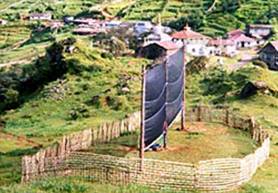
Using fine polypropylene meshes stretched between two poles, where fog laden winds prevail, does fog harvesting. Fog passes through the mesh, forming large drops of water that run down into a gutter leading to a reservoir. Originating in the coastal areas of Chile this has been successfully tried out in eastern Nepal and shows great promise in the eastern Indian Himalayas as well. This technology is best suited to areas where fog is consistently available and can be intercepted. Fog should occur during the season when water is most needed. Other important considerations are : a mountain range with an average altitude of 500 metres or higher; the principal axis of the range should be perpendicular to the prevailing wind (this increases the amount of water collected); the site for water collection should be as close as possible to the user community. Interestingly, a beetle that lives in the Namib Desert, one of the hottest places on Earth, survives by using its bumpy shell to draw drinking water from periodic fog-laden winds. Scientists have been working to mimic this property and efforts are being made to develop tenting material and this promises to improve the efficiency of this technique many fold.
Spring recharge
Significant efforts are underway to address the issue of recharging of spring sources and nuclear radioisotope tracking and testing has been undertaken in a few watersheds to determine the scientific parameters impacting these natural phenomena. Combined with adequate biological plant based solution mechanisms this is another way of addressing the depleting water resource issue.
Looking ahead
The ever-increasing need for water in the hills combined with the depletion of available sources and quantities is a challenge that merits attention from all quarters. The gradual decline of traditional water management systems and methods remains a matter of concern. The need for “think global, act local” tools and mechanisms to permit tapping local knowledge with the latest scientific tools and techniques and providing a holistic solution cannot be over emphasised. In this context the Govind Ballabh Pant Institute of Himalayan Environment and Development, India; Himalayan University Consortium, Nepal; National Institute of Disaster Management (NIDM), India; Nepal Water Conservation Foundation, Nepal Department of Hydrology and Meteorology, Nepal; Wadia Institute of Himalayan Geology, India are all working together as knowledge partners at ICIMOD to provide a focus to water related issues. Much remains to be done but efforts are in hand to provide the necessary inputs and support to permit the well being and upliftment of the communities in the hills to water related issues.
|