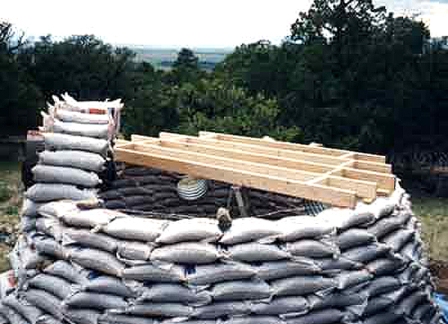
On has often seen earth-bags being used by the military forces to create bunkers. Most commonly, the material of the bag is polypropylene or burlap, polypropylene being more durable than burlap. Usually the bags are filled with sand, clay and gravel. However, researchers have been exploring their potential use in building houses, since the thirties and forties. In fact the Colombian community of Gaviotas has been using earth-bags as construction material for many years in creating ponds and retaining walls (gabions).
As a building material, earth-bags are economical and relatively simple to use. They can be filled with almost anything and used anywhere. Its lightweight and easy transportation makes it suitable for a variety of conditions and locations. An added advantage of using earth-bags is that the tool requirement is minimal.
In deciding its use as building material, it is important that the bag is made up of UV resistant material. In terms of the filling- an ideal mixture is sand and clay, and whatever subsoil is available. This fill material can be either wet or dry, moistened material makes for a more stable structure. An efficient system is to create the sack foundation and/or walls using soil from the site excavation. One must keep in mind that if the fill material is weak then the bag has to be strong and vice versa. Some of the other materials used in construction include barbed wire, that can be put to use for preventing the bags from slipping, and regular wire, which is used to weave the bags in a manner similar to basket-making techniques. Wood or metal can be used with the earth-bags to create vaults, and a simple compass can be used as a guide for making domes.
The construction process is simple. It starts with site preparation where a rubble trench foundation is used as a base for the bags. The fill material can be derived from the excavation of the site. The material removed from the foundation area can be set aside to fill the bags, while the topsoil and organic materials is kept apart, the subsoil can be mixed with large rocks to prepare the fill material. It should be ensured that there are no sticks in the fill material. For smaller site walls, the fill material can be dry, but it is better for structural purposes, that the fill material is moistened and left overnight. It is preferable to fill the bags on-site in order to avoid having to pick up and move the heavy bag.
If the bags are being used as a foundation for the construction, then the bags should be filled with gravel to at least a foot above ground, with the final row relatively level to receive the next building material (straw bales, adobe, wood, etc.). A thin layer of concrete with proper reinforcing can also be poured on top of the bags to create a grade beam and level surface from which to build. Earth-bags work well as foundation for straw-bale construction. A waterproof membrane between the top of the bags and the bottom of the bales is required in most cases.
The bags can also be used to make the retaining walls but it is important to provide proper drainage behind the wall. Slight "battering" (sloping back) of the wall can help, as well as compacting the bags at a slight angle toward the terrain for added stability.
Persian architect Mr. Nader Khalili, with his students and associates, has built a number of prototype structures at his school and research center at the California Institute of Earth Art and Architecture. There are about five structures that have been built at by them with more coming up. He has dubbed the technique "superadobe." They are planning to construct a three-vault house using earthbags and are working closely with the building authorities to obtain code approval for buildings built with earth-bags. |