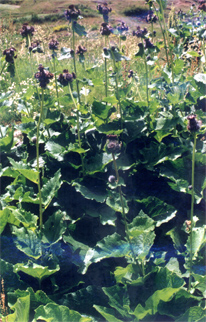
| Distribution and habitat:The plant is found at an altitudinal range of 2600-4000 m on moist slopes. It is adapted to grow in river basins and valley ridges with moisture. It is commonly noted in Lahaul (Jispa and Sardara) in Himachal Pradesh, in Chamoli, and Pithoragarh in Uttarakhand and in Tawang in Arunachal Pradesh. |
| Environment for growth:The plant thrives well in slightly acidic to near neutral conditions. It prefers coarse porous soil with sandy-loam texture. It has been found to be least tolerant to water logging and improper drainage. The plant exhibits optimum growth conditions at altitude ranges of 2600-4000 m. The tolerable thermal range for the species varies from 15-35ºC. However, plant growth has been noted to be optimal under the range of 15-25ºC in the high altitude regions of the Himalayas. |
| Parts used:Roots |
| Market rate:The market value of 1 kg root tuber ranges from Rs. 125-175/kg dried roots. |
| Agro-technology: |
| Means of propagation:The plant can be propagated through seeds or root cuttings. The seeds show negligible levels of dormancy that make it easy for the propagation of the species. Germination at altitudes above 3500 m has been noticed 14-8 days after sowing. However, altitudinal variations were noted in the case of reduced mean germination time of 2-3 days for the species at lower elevations. Crops sown in April have higher growth vigour as compared to crops sown in October. |
| Collection of Seeds:The seeds should be collected from healthy, mature plants in the month of August-September depending on the flowering season. The mature seeds are brownish-black and crescent shaped and seeds should be collected and dried in partial shade before storage. The moisture content of the seeds should be minimum, preferably in the range of 14-16% for optimal storage and maximum viability. |
| Seed treatment and germination:The seeds should be collected from healthy, mature plants in the month of August-September depending on the flowering season. The mature seeds are brownish-black and crescent shaped and seeds should be collected and dried in partial shade before storage. The moisture content of the seeds should be minimum, preferably in the range of 14-16% for optimal storage and maximum viability. |
| Land preparation and soil work:The land is ploughed into a fine tilth after crop stubble, boulders, deep-rooted sedges and weeds are removed. The clods or hardened masses of soil are to be broken because they can impede germination of the seeds. The land attains a fine tilth after 2-3 rounds of deep ploughing after which, well rotten farmyard manure is mixed with the soil at the rate of 3500 kg/ha (280-300 kg/bigha). A sufficient gradient is provided to the land by ploughing and leveling of the soil for facilitating drainage. |
| Nursery preparation:The recommended seed rate for the species is 6.5-7.5 kg/ha. The most common method of sowing practiced is line sowing. The spacing recommended for nursery beds is 30 cm between plants and 45 cm between rows. A higher spacing is recommended between the rows to accommodate a higher leaf expanse of the growing plants. A larger spacing of 60 x 60 cm can be used between the rows and plants in case of plantations where transplanting is not being done. The same spacing can be used in case of planting of root cuttings. Beds of uniform size are prepared across the slope of the land, depending on the area and shape of the land available. Raised beds can be prepared in areas of heavy rainfall or precipitation. The height of such beds should be determined by the soil texture and water holding capacity of the soil. The normal height for a raised bed would be 15-20 cm in areas of moderately heavy rainfall to facilitate the seepage of water. Raised beds of 10-15 cm height can be prepared in high precipitation areas with predominantly sandy soil. A bed size of 4.5 x 6 feet is ideal in nurseries to facilitate tending and inter-cultural operations like weeding and irrigation. Sunken beds are advisable for cold desert areas with a precipitation rate. Sowing is done in lines at fixed spacing and depths of 1-2 cm. A layer of topsoil should be placed over the seeds prior to irrigation. Placing the seeds at depths greater than the recommended can lead to poor germination or increased mean germination time for the species. Light irrigation is necessary after seed sowing. |
| Transplantation:Transplanting from the nursery beds to the field can be done after the crop attains a sufficient root girth by the end of 6-8 months. Under field conditions, successful transplantation can be obtained in case of one-year-old plants. Plants raised by early sowing (April) can be transplanted in March-April of the next season, where as the pre-winter sown crops are ready for transplanting in September-October of the following year prior to the onset of winter. |
| Vegetative propagation:Vegetative propagation can be done through root cuttings obtained from 2.5-3 year old crops. The plants raised through root cuttings mature quickly and can be harvested within 1-1.5 years of planting. Root cuttings should avoid damaging the main taproot of the plant. The root splits should ideally have one or two growth buds to aid germination. The cuttings should be kept in moist Sphagnum (moss) or peat to avoid dehydration of the plant tissues prior to planting. Treatment of the root splits with Rootex or Keradix, which are commercial forms of Indole Butyric Acid (IBA) have been noted to effect faster germination of root cuttings. One round of light irrigation is recommended for the plants after sowing or transplanting is done in the field. Mulching is advisable in the initial stages of crop growth to avoid damage due to solar radiation and dry winds. |
| Water management:The species performs well under moderately moist to moist conditions. The seedlings in the initial stage require frequent irrigation at shorter periods of a week or once in 10 days. The frequency can be extended to once in 10-14 days after leaf differentiation. Light irrigation should be followed in the post-sowing phase to avoid erosion of nutrients and seeds. In areas with steeper gradients, controlled irrigation once in 10-14 days is advisable. The number of irrigations given to the crop should ideally depend on the stage of growth, soil texture and availability of irrigation. Alternate and improved systems of irrigation should be adopted in case of water scarcity. This can include sprinkler, pot and wick and drip irrigation methods, as it will help in increased water use efficiency and minimal wastage. |
| Weed and pest control:Regular weeding in the initial stages of crop-establishment is necessary. As the crop grows, the leaf expanse of the species prevents the growth of weeds in the vicinity. However, deep-rooted sedges should be removed as and when they appear. The weed population should not be allowed to attain flowering and fruit setting stages. Weeding should be done after light irrigation, as it helps in uprooting the weeds. A pre-winter weeding (September-October) and a pre-season weeding (March-April) can effectively help in the regeneration of the crop in the post winter period. The disease infestations noted in the region are mainly confined to leaf spots and powdery mildew. Powdery mildew infestation can be controlled by application of sulphur containing organic (plant extracts from Allium) or inorganic (nitrophenol, orthoquinox and sulphur dust) compounds. Control of leaf spot diseases in the region can be done by applying organic plant based extracts of neem and garlic. Common bio-control agents used in the high altitude regions include neem oil and Artemisia based extracts. Pest infestation in the high altitude region is notably lower when compared to other regions due to the adverse agro-climatic conditions including low atmospheric moisture, high amount of solar radiation and greater distance between the cultivated fields that make multiplication and spread of the pathogens and pests a difficult proposition. However, leaf feeders including grasshoppers, beetles, plant hoppers and white flies are found in the area. Neem oil and Artemisia-neem oil mixtures are effective to control leaf feeders. A prophylactic spray of neem-based formulations on a monthly basis would be advisable for areas adjoining cultivated fields or areas with sizable weed population. Burning of weed and crop stubbles prior to seed sowing and avoiding water stagnation in the field can help in prevention and control of spread of pests and diseases. |
| Maturity and harvesting:The plants are ready to be harvested after 2.5 years. The roots can be dug and collected in mid-August to mid-September, though this period varies from region to region. Light irrigation is given prior to harvest. Separation of root cuttings as propagules can be done simultaneously by separating and transplanting the apical portions of the tubers in the field. |
| Post harvest technique:The dug up roots are washed thoroughly in running water and dried under partial shade. A moisture level of 18-22% should be maintained for longer shelf life. They are kept in closed containers or gunny bags to retain the aroma. |