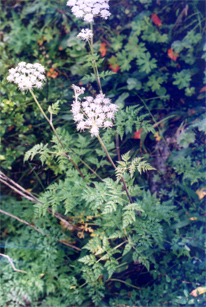
| Distribution and habitat:It is an erect, tall, glabrous and hairy, perennial herb with biennial tubers. The plant is common in temperate and moist alpine pastures in open grassy slopes under dry moist conditions in association with certain species of Angelica and Polygonum and occurs at an altitudinal range of 2000-4000 m. The plant is distributed in Chhota and Bara Bhangal area of Kangra, Holi range of Chamba, Parvati valley and Rohtang in Kullu and Rampur and Rohru division of Shimla district. |
| Environment for growth:The plant exhibits optimum growth conditions at altitude ranges of 2500-3200 m. The tolerable thermal range for the species varies from 15-35ºC. However, the plant growth has been noted to be optimal under the range of 15-25ºC in the high altitude regions of Himalayas. The plant prefers well-drained soils and can grow in semi-shaded areas with a soil pH of 5.8-6.2. |
| Parts used:Roots and seeds |
| Market rate:Roots are sold in Himachal Pradesh at the rate of Rs.75 per kg |
| Agro-technology: |
| Means of propagation:The seeds from natural pockets are collected in September-October. These should be dried in shade. Selenium is easy to cultivate through seeds in large scale. Harvesting of the crop is done in the month of October in the third year. |
| Seed treatment and germination:The plant can be propagated through seeds or root cuttings. The seed requirement is 5 g/1000 plants. The seeds show negligible levels of dormancy making it easy for propagation. April sown crops have higher growth vigour when compared to pre-winter sown crops in October. The appropriate time for seed collection is October, just after which, the seeds are sun dried and stored at room temperature. Seed germination takes place after 4-6 weeks. |
| Land preparation and soil work:The land is ploughed into a fine tilth after the crop stubble, rocks, deep-rooted sedges and weeds are removed. Soil compaction resulting from snowfall must be removed by digging up of the soil. The land attains a fine tilth after 2-3 rounds of deep ploughing after which, well rotten FYM is mixed with the soil at the rate of 3500 kg/ha (280-300 kg/bigha). Leveling of the field has to be done and slope is to be maintained within the beds and between the beds to facilitate irrigation. |
| Nursery preparation:The best time for seed sowing is November-March. The recommended seed rate for the species is 5 g/1000 plants. The most common method of sowing practiced is line sowing. The seed rate can be further lowered in case of seed dibbling or individual placement in lines or rows between the beds. The spacing recommended for nursery beds is 40 cm between plants and50 cm between rows. A higher spacing is recommended between the rows to accommodate a larger leaf expanse of the growing plants. A larger spacing of 60 x 60 cm can be used between the rows and plants in case of plantations where transplanting is not to be done. The same spacing can be used for planting root cuttings. |
| Transplantation:Beds of uniform size are prepared across the slope of the land, depending on the area and shape of the land available. Raised beds can be prepared in areas of heavy rainfall or precipitation. The height of such beds should be determined by the soil texture and water holding capacity. The normal height for a raised bed is 15-20 cm in areas of moderately heavy rainfall. This facilitates seepage of water into deeper layers. Raised beds of 10-15 cm height can be prepared in high precipitation areas with a predominantly sandy soil, as compaction is not possible in such soils. A preferable bed size of 4.5 x 6 feet is ideal for nurseries to facilitate tending and inter-cultural operations including weeding, plant protection and irrigation. Sunken beds are advisable for cold desert areas with a low precipitation rate. Sowing is done in lines at fixed spacing and depths of 1-2 cm. A layer of topsoil should be placed over the seeds prior to irrigation. Placing the seeds at depths greater than the recommended depth can lead to poor germination or increased mean germination time for the species. Light irrigation is necessary after seed sowing in the beds. For first 2-4 weeks, the seeds should be kept warm (18-22ºC) and moist. After this period sowing must be kept at cold temperature (-4-4ºC ) for about 4-6 weeks. It is beneficial to cover the seeds with snow as melting snow helps in germination. Seedlings should be transplanted in the month of March, April or May in open fields, cold frames or cold green houses. |
| Vegetative propagation:Vegetative propagation can be done through the apical part of the roots, which have buds. The cuttings are sown in beds with sand to soil ratio of 1:1. The plant to plant distance must be 30 cm. The crop should be irrigated minimum thrice a week. |
| Water management: Selinium tenuifolium has been found to perform well under moderately moist conditions. The seedlings require frequent irrigation at shorter periods of a week or once in 10 days in the initial stages. In areas with greater slopes and steeper gradients, controlled irrigation once in 10-14 days is advisable. The number of irrigations given to the crop should depend on the stage of growth, soil texture and availability of irrigation. Alternate and improved systems of irrigation should be adopted in case of water scarcity. This can include sprinkler, pot and wick and drip irrigation methods, as it will help in increased water use efficiency and minimal wastage. |
| Weed and pest control:The weed population should not be allowed to attain flowering and fruit setting stages. One weeding per month is ideal after the plants are well established. Weeding should be done after a light irrigation in the field for facilitating uprooting of the weeds. A pre-winter weeding (September-October) and a pre-season weeding (March-April) can effectively help in the regeneration of the crop in the post winter period. The disease infestations noted in the region are mainly confined to leaf spots and powdery mildew. Powdery mildew infestation can be controlled by application of sulphur containing compounds of organic or inorganic nature. Leaf spot diseases can be controlled by the application of organic plant based extracts of neem and garlic. Pest infestation in the high altitude region is notably lower when compared to other regions. However, leaf feeders including grasshoppers, beetles, plant hoppers and white flies are found in the area. Neem seed oil, neem oil and Artemisia-neem oil mixtures are found to be effective in case of control of leaf feeders. A prophylactic spray of neem-based formulations on a monthly basis is advisable for areas adjoining cultivated fields or with a sizable weed population. Burning of weed and crop stubble prior to seed sowing and avoiding water stagnation in the field can help in prevention and control of spread of pests and diseases. |
| Maturity and harvesting:The crop is harvested in the third year during October. |
| Post harvest technique:The roots are dried properly in air and stored in gunny bags. |