| Plant Profile: |
|
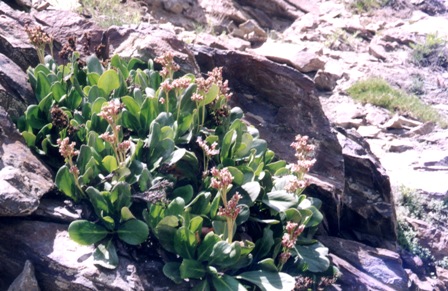
The plant is distinguished by its large thick leaves with a stout flowering stem arising from the rootstock. It is an erect, fleshy, perennial herb with leaves that are obovate and ciliate. The flowers are white or liliac and borne in terminal loose corymbs. The capsule is ovate-lanceolate and has minute seeds. The plant is commonly found from Kashmir to Uttar Pradesh between 3300-4500 m. It prefers sheltered, moist, but well-drained sites, where it usually grows in colonies, particularly between boulders, where a long lasting snow cover provides adequate water or on the edge of rivers or ponds. Flowering and fruiting occurs in June-September. It is mostly harvested from the wild in the month of September-October by digging up the rhizomes.
|
| Medicinal uses: |
| Parts used: Rhizomes |
| Active principles: The rhizome contains bergenin (0.75%), Beta-sitosterol and catechin 3-gallate. Mucilage, wax and glucose (5.6 %) have also been reported to be present in the plant. |
Disease cured and dosage:
- Ethnomedicinal: It is used as a tonic, and as a cure for fever, diarrhoea, wounds, eye diseases, cuts and wounds. It is also used in the treatment of menorrhagia. In Lahaul the root s are used for poulticing in stiff joints and removal of kidney stones. The root powder has been used as a diuretic.
- Ethnoveterinary: Data not sufficient
|
| Ayurveda/Unani prepration: Pashanbhedadi-kwath, Pashanbhedadi-ghrita, prescribed dose: churna: 3-6 g, kwath: 50-100 ml. |
Ayurvedic properties and actions:
- Guna (Qualities): laghu (light), snigdha (slimy), tikshna (sharp
- Rasa (taste): kashay (astringent), tikta (bitter)
- Vipaka (post digestive taste): katu (pungent)
- Virya (potency): sheet (cold)
- Prabhav (effects): Ashmari-bhedan (effective against calculous)
As per Charaka Samhita it is considered a mutravirechaniya (diuretic).
|
Therapeutic description:
- Effect on humours: It is known to alleviate vata, pitta and kapha.
- Systemic effects: It is used to treat wound inflammation, conjunctivitis and applied at the time of teeth origin in children (with honey).
- Respiratory system: It gives relief during cough.
- Digestive system: It is used as a cure for diarrhoea, dysentery and piles.
- Blood vascular system: It is used during the treatment of cardiac diseases and haemorrhage.
- Urino-genital system: It is used in the cure for renal calculous, dysurea, dysmenorrheal and leucorrhea.
- Temperature: It is used to cure mild fever.
|
Drug preparation: To convert the plant into a drug, the root is cut into small pieces and dried in partial shade. The dried pieces are then ground into fine powder and used as medicine either in the form of powder or pills/tablets.
- It must be stored in airtight moisture free containers.
- The drug is applied as poultice or soft paste.
|
|
|
 |
|
| Family:
Saxifragaceae |
| Common name:
Aconite, Monk’s hood, Vatsanabh, Mithavish, Safed Vish, Dudhia Vish |
| Local name: Shilpada (Lahaul), Shilpada (Spiti), sha por chii (Tibetan), Pashanbheda (Hindi) |
| Ayurvedic name:
Pashanbheda |
|
|
|
| File Size:526.3623046875kb |
|
|




