| |
|
|
|
| Plant Profile: |
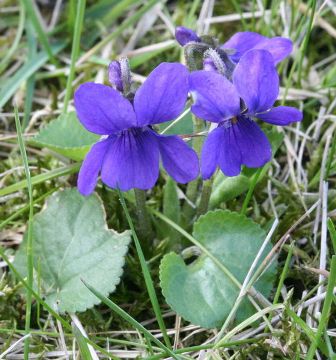
| It is a perennial herb with a short thick rhizome and creeping stolons that root at their tips. The cordate, crenate or toothed leaves are arranged in a basal rosette from which arise the solitary long stalked, fragrant, violet or white, rarely pink flowers. The flowers have two erect upper petals, two spreading lateral petals and a lower spurred petal. The fruit is a globose hairy capsule. There are several garden varieties of this species and in some countries the sweet violet is cultivated commercially for the perfumery industry. The plant is found in temperate zone of Kashmir and western Himalaya at 4000- 6000 m. |
| Medicinal uses: |
| Parts used: Leaves, flowers and rhizome |
| Active principles: It contains an emetic substance named violine. 2% rutine, 3-5% cyanine. The root contains 0.1-2.5% an alkaloid odoratin called saponin. The flowers contain a volatile oil. |
Disease cured and dosage:
- Ethnomedicinal: Sweet violets have expectorant and diuretic properties and are used for bronchitis, whooping cough and head colds. It is also a component of diuretic tea mixtures that alleviate rheumatic pain. Externally it is included in compresses applied to swelling, slow healing wounds, ulcers and rashes and in mouthwashes or gargles. It is used in vata-kaphaj diseases, hepatic diseases and constipation. It is also used in hypertension and diseases of blood and respiratory disorders.
- Ethnoveterinary: Data not sufficient
|
|
Ayurveda/Unani prepration: Banafshadi-kwath (decoction) Prescribed dose 3-6 g.
|
Ayurvedic properties and actions:
- Guna (Qualities): Ruksha (dry), tikshna (sharp), laghu (light), vikashi (intracellular space)
- Rasa (taste): Madhur (sweet)
- Vipaka (post digestive taste): Madhur (sweet)
- Virya (potency): Ushna (hot)
|
Therapeutic description:
- Effect on humours: Alleviates vata, pitta, kapha
- Systemic effects: Used to treat sciatica, arthritis, headache
- Nervous system: Treats paralysis and nervine debility.
- Respiratory system: It is used to cure bronchitis, dyspnoea, cough and pleuritis.
- Digestive system: It is used in the treatment of dyspepsia, abdominal colic, digestive upsets, liver and spleen disorders.
- Urino-genital system: Used in nocturnal enuresis (bed wetting), polyurea, glycosuria, spermatorrhoea and amenorrhoea.
- Temperature: Treats inflammatory fever
|
Drug preparation: To convert the plant into a drug, the tuberous roots are dried under sun/partial shade, powdered and used in powder or tablet/pill form
- The powder is sweet in taste and causes a tingling sensation and parasthesia of the tongue. It is blackish-brown in colour.
- The powder should be stored in airtight moisture free containers.
- The shelf life of the powder is 6 months and one year for the pills/tablets.
- It can be externally applied with mustard oil as massage in neuralgia, paralysis and rheumatism. For internal use, the root is smoked if one is suffering from toothache and body pain.
|
|
|
 |
|
| Family:
Violaceae |
| Common name:
Wild/sweet violet |
| Local name: Nirbishi (Joshimath), Vanafsha (Hindi) |
| Ayurvedic name:
Banapsa, Vanaphsa, Vanspika |
|
|
|
| File Size:971.21875kb |
|
|
|
| |
| |
|
|




