| Plant Profile: |
|
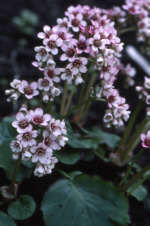
It is a rhizomatic perennial herb, which grows in rocky and shady places. The stem is short, thick and fleshy. The leaves stalked, ovate or orbicular and cordate. The margins are fringed with short and stiff hairs. The rootstock is thick, dark brown from outside and pinkish from within. The flowers are white, pink or purplish and borne in terminal corymbs. The fruits are cone-like capsules. The plant is found throughout temperate Himalayas from Kashmir to Bhutan between 2700-3000 m and in the Khasi hills at 1300 m. In Himachal Pradesh it is abundant in Sirmour, Shimla, Mandi, Kullu, Kangra, Chamba and Kinnaur districts between 1800-2800 m elevation on moist, rocky slopes and more frequently on rock boulders in ravines and nallahs. It prefers rocky moist shaded sites with a layer of humus rich soil to facilitate horizontal spreading of the rhizomes. It is easy to propagate Bergenia ciliata through rhizome cuttings. The rhizomes are harvested in autumn, cut into small pieces, dried in the sun, graded and stored in sacks.
|
| Medicinal uses: |
| Parts used: Rhizomes |
| Active principles: Rhizome contains gallic acid tannic acid, mucilage, wax and glycoside. |
Disease cured and dosage:
- Ethnomedicinal: The rhizomes and root taste bitter, act as an astringent, diuretic, tonic and are also used in fever and applied to boils and given during asthma. It is also very useful in kidney and bladder stones.
- Ethnoveterinary: Data not sufficient
|
| Ayurveda/Unani prepration: Pashanbhedadi-kwath, Pashanbhedadi-ghrita. Prescribed dose: churna: 3-6 g, kwath: 50-100 ml. |
Ayurvedic properties and actions:
- Guna (Qualities): Laghu (light), snigdha (slimy), tikshna (sharp)
- Rasa (taste): Kashay (astringent), tikta (bitter)
- Vipaka (post digestive taste): katu (pungent)
- Virya (potency): Sheet (cold)
- Prabhav (effects): Ashmari-bhedan (effective against calculous)
As per Charaka Samhita, it is considered as mutravirechaniya (diuretic).
|
Therapeutic description:
- Effect on humours: Alleviates vata, pitta and kapha
- Systemic effects: used to treat wound inflammation and conjunctivitis.
- Respiratory system: It is used to cure coughs.
- Digestive system: Treats diarrhoea, dysentery and piles.
- Blood vascular system: It is used in the treatment in cardiac diseases and haemorrhage.
- Urino-genital system: Cures renal calculous, dysurea, dysmenorrheal and leucorrhea.
- Temperature: used to treat mild fever.
|
Drug preparation: To convert the plant into a drug, the roots are dried and cut and then ground into a powder.
- The powder must be stored in airtight containers.
- The powder has a shelf life of one year.
- Externally it can be used as a soft-paste and internally the powder can be taken with honey.
|
|
|
 |
|
| Family:
Ranunculaceae |
| Common name:
Aconite, Monk’s hood, Vatsanabh, Mithavish, Safed Vish, Dudhia Vish |
| Local name: Patharchat (Lahaul) Pakhanbheda, Silphara, Patharchur (Hindi) |
| Ayurvedic name:
Pashanbhed, Ashmaghan |
|
|
|
| File Size:220.3486328125kb |
|
|




