Himalayan VOICES High Himalaya FORUM Himalayan Heritage  
 
Search
 
 
View more Databases:
CULTURAL RESOURCES
Tribes
Socio-economic Fabric
Language & Literature
Art, Crafts & Architecture
 
Species:        Betula utilis D.Don
Plant Profile:

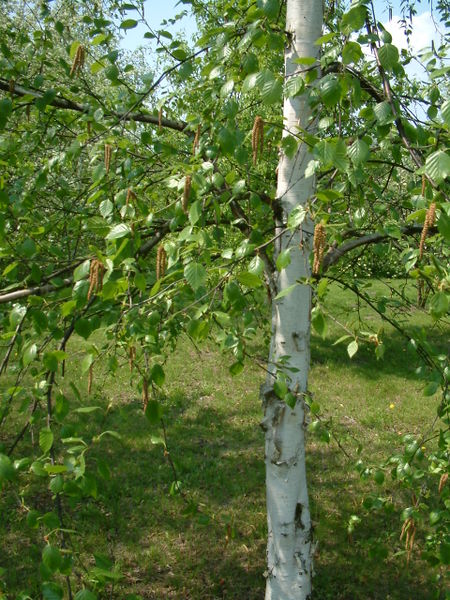
 This plant can be easily distinguished by the nature of its bark, which gets peeled off easily from the main trunk in layers on which one can write. Betula is a small deciduous tree with white bark and conspicuous long horizontal lenticels. The inner layers are pink and peel off in large papery layers. The twigs are dotted with yellow resinous drops. The young shoots, petioles and leaves are silky and become glabrous as they grow older. The leaves are 5-10 cm long, ovate, acute, sharply irregularly serrate, base broadly cuneate or rounded and rarely subcordate. It is a deciduous tree or shrub found at an altitudinal range varying from 2700-4300 m just near the tree line in the dry temperate to dry arid zone with a preference for sandy soils. Flowering occurs from May-July and fruiting occurs from September-October. The best quality of bark is obtained during March-April, when they come out in large flakes.

Medicinal uses:
Parts used: Bark
Active principles: The stem and bark of this plant contains alkaloids, volatile oil and betuline. The outer bark contains leucocyanidin, betulin, lupeol, oleanolic and ac-oleanolic acids and the inner bark contains betulin and karachic acid.
Disease cured and dosage:
  • Ethnomedicinal:  A dark decoction made from the bark is used as an antiseptic for washing wounds and as a tonic for blood related diseases. The bark is also used for curing redness in the eyes by burning a piece of it before the eyes of a patient in the morning and quickly extinguishing it in water contained in a bronze vessel. The bark is beneficial for earaches and used as wash in otorrhoea. A paste made from bark is applied in the vaginal wall in order to expel the retained placenta. Its decoction is used as a vaginal douche to avoid conception. The fungal outgrowth on the bark is applied locally against muscular pain and swellings.
  • Ethnoveterinary:  Data not sufficient
Ayurveda/Unani prepration: Bhurjapatra-churna, bhurjapatra-kwath. Prescribed dose: churna 3-6 g, kwath 5-10 ml.
Ayurvedic properties and actions:
  • Guna (Qualities):  Laghu (light)
  • Rasa (taste):  Kashaya (astringent)
  • Vipaka (post digestive taste):  Katu (pungent)
  • Virya (potency):  Ushna (hot)
  • Prabhava (effects):  Tridoshaghna (alleviates three humours)
Therapeutic description:
  • Effect on humours:  Alleviates vata, pitta and kapha.
  • Systemic effects:  Helps treat wounds (cleaning with its decoction), otalgia and ottorrhoea (cleaning with its decoction).
  • Nervous system:  It is used to treat psychosomatic disorders, epilepsy and tetanus.
  • Respiratory system:  Treats productive cough.
  • Digestive system:  Use to cure diarrhoea and dysentery.
  • Blood vascular system:  It is useful to treat external and internal haemorrhage. 
Drug preparation:   To convert the plant into a drug, the dried bark is ground into a powder and then used as medicine. A decoction is prepared by boiling the powder in water.
  •  The powder is light brown in colour and must be stored in damp free containers.
  •  It has a shelf life of one year.
  •  The medicine can be taken as a decoction or paste.
Family: Betulaceae
Common name: Birch tree, Bhurjapatra, Bhojpatra
Local name: Bhojpatra, bhujpatra (Himachal), Shag (Lahaul), Bhojra, Bhujpat (Joshimath), Bhojpatra (Hindi)
Ayurvedic name: Bhurjpatra, Lehyapatrak
File Size:895.076171875kb
Download