| |
|
|
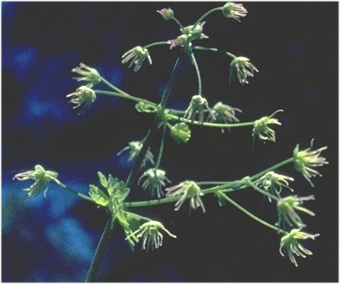
| Species: Thalictrum foliolosum DC |
|
|
| Plant Profile: |
| It is an erect, rigid, perennial herb up to 2.5 m tall. The rootstock is fibrous yellowish-brown, resembling liquorice but knotty and extremely bitter to taste. The leaves are pinnately decompounds with 4-6 sub-orbicular, slightly lobulate leaflets. The flowers are usually pale-green often dingy-purple, polygamous and arise in branched terminal panicles. The achenes are 3.75 cm long and sharply ribbed. It is found wild in the temperate Himalayas at an altitude of 1300-3400 m. Flowering occurs in the month of June and fruiting in October. The plant prefers partially shaded aspects and light soil. |
| Medicinal uses: |
| Parts used: Root stock and rhizome |
| Active principles: The rhizomes contain large quantities of water-soluble salts of berberine (0.35%) besides magnoflorine (thalictrine), palmitine (0.03%) and jatrorrhizine (0.02%). |
Disease cured and dosage:
- Ethnomedicinal: The rhizomes and roots are used in the form of a decoction, extract or powder and are valued for the treatment of ophthalmic disorders. It is used in preparations of various types of collyriums. The root is used as an anti periodic, diuretic, aperient, purgative and a bitter tonic during convalescence. It is also given for atonic dyspepsia. The paste of the plant is locally used in skin diseases and to suppress boils.
- Ethnoveterinary: Data not sufficient
|
| Ayurveda/Unani prepration: Classical Ashchyotan (eye drop) formulation. Prescribed dose: churna: 1-3 g, aschyotan: 1-2 drops. |
Ayurvedic properties and actions:
- Guna (Qualities): Ruksha (dry)
- Rasa (taste): Tikta (bitter)
- Vipaka (post digestive taste): Katu (pungent)
- Virya (potency): Ushna (hot)
|
Therapeutic description:
- Effect on humours: Alleviates pitta, kapha
- Systemic effects: Cures conjunctivitis (paste), corneal opacity, cataract common ophthalmic disorders (surma), leucoderma and skin diseases (paste).
- Respiratory system: It is used to treat bronchitis, dyspnoea, cough and pleuritis.
- Digestive system: Treats dyspepsia, cholera and obstructive jaundice.
- Blood vascular system:: Treats inflammatory disorders.
- Urino-genital system: It is used to cure pyourea and dysurea.
- Skin: It is used in the treatment of leucoderma and other skin diseases.
- Temperature: Used in the treatment of malaria and typhoid.
It is used in snakebites externally as well as internally .
|
Drug preparation: To convert the plant into a drug, the dried rhizomes are ground into a fine powder. It is boiled with water to prepare a decoction.
- Since the rhizome loses its activity on storage, it is advisable to use the material fresh.
- It is externally used as a poultice of paste in skin disease and boils. Internally, it can be taken as a decoction.
|
|
|
 |
|
| Family:
Ranunculaceae |
| Common name:
Pilijari, Chaitra |
| Local name: Bhonga-nagpo (Lahaul), Mamiree (Joshimath), Piyaranga, Pili jadi (Hindi) |
| Ayurvedic name:
Pitranga |
|
|
|
| File Size:193.5kb |
|
|
|
| |
| |
|
|




