| Plant Profile: |
|
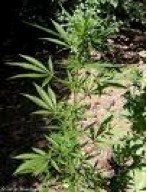
The plant can be distinguished by its strong characteristic smell. It is an erect annual herb with digitate leaves. The stem is slender, grooved and finely tomentose while the leaves are alternate, palmate and divided into 5-20 cm long toothed segments. The upper leaves have 1-5 linear lanceolate long pointed leaflets. All the leaves are long stalked, gland dotted pale and very finely downy beneath. The stem of the plant is grooved, having fine hairy with slender branches. The plant is dioecious with male flowers being clustered in drooping panicles while the female flowers are sessile and erect. The perianth is a single, entire leaf enclosing the ovary while the achenes are small rounded and dark grey in colour. It is commonly found across a large range of elevations on wastelands and edges of fields. It is also cultivated in temperate and sub-temperate regions of the western Himalayas. This pistillate plant is native to Persia, Western and Central Asia and is now largely cultivated all over India. When grown in the hot areas of the tropics, the plants (especially the female plants) yield a quantity of resin possessing remarkable intoxicating properties. Flowering occurs in the month of June while fruiting occurs in the month of October.
|
| Medicinal uses: |
| Parts used: Leaves and flowering/fruiting tops. |
| Active principles: Indian hemp comprises 15-20% of resin (present in glandular trichomes), which contain the major active euphoric principle 1-3-4 trans tetra-hydrocannabinol. It contains volatile oil, trigonelline and choline. The resin contains cannabinol, cannabidiol, cannabidiolic acid, cannabichromene and cannabigerol. Indian hemp seeds contain about 20% of fixed oil. |
Disease cured and dosage:
- Ethnomedicinal: In Lahaul valley it is used by the community for pain relief. It is a narcotic, sedative and analgesic. It causes euphoria in small doses and causes in-coordination of movements, speech and intoxication in larger doses. The plant has certain medicinal properties if used in adequate doses. It is an appetizer, laxative, nerve stimulant, sleep inducing, anthelmintic and can be prescribed in various ailments like dyspepsia, insomnia, skin troubles, bronchitis, ear complaints, eye diseases and also for bowel complaints. It is purified by boiling in milk.
- Ethnoveterinary: Data not sufficient
|
| Ayurveda/Unani prepration: Jatiphaladi-churna, Madananand-modak, Prescribed dose: leaves 125-250 mg, ganja (inflorescence) 60-125 mg and charas 30 mg. |
Ayurvedic properties and actions:
- Guna (Qualities): Laghu (light), tikshna (sharp)
- Rasa (taste): Tikta (bitter)
- Vipaka (post digestive taste): Katu (pungent)
- Virya (potency): Ushna (hot)
- Prabhav (effects): Madak (sedative)
|
Therapeutic description:
- Effect on humours: Alleviates vata, kapha
- Systemic effects: Used to treat piles and other anal disorders (paste and smoke). It also acts as fomentation agent in vata-kafaj disorders.
- Nervous system: It is used to cure headache, hemi-crania, insomnia, convulsions, tetany and other vataj diseases.
- Respiratory system: Cures pertusis and dyspnoea.
- Digestive system: Used to treat dyspepsia, abdominal colic, digestive upsets, IBS (irritable bowel syndrome) piles and liver disorders.
- Urino-genital system: Treats incontinence of urine, renal colic, premature ejaculation and dysmenorrheal.
- Skin: It is also used in the treatment of leprosy, erysipelas and other skin diseases.
- Temperature: Treats malaria, typhoid and chronic fever.
|
Drug preparation: To convert the plant into a drug, the leaves and flowering tops of the female plants are cut and completely dried by exposing to sun and dew for a few consecutive days. Only the female plants are used for medicinal preparations. Another traditional way to collect the resin part is by crushing the flowering tops and leaves in between the palms. The resinous part is sticky and comes into the palm in thin layers while crushing, which is later separated by rubbing the palms.
- The drug is dull green in color with a characteristic odour and somewhat acrid and pungent taste.
- After complete drying, the plant parts must be stored inside moisture free earthen pots.
- It is externally taken as dried leaves or the resinous exudates are smoked. A special drink is prepared from bhang, which is taken during various religious occasions like the Hindu festival of Holi.
|
|
|
 |
|
| Family:
Cannabinaceae |
| Common name:
Indian hemp, Ganja, Hashish, Vijaya |
| Local name: Bhonga-nagpo (Lahaul), Bhang (Joshimath), Bhang (Hindi) |
| Ayurvedic name:
Bhanga, Madani, Matulani |
|
|
|
| File Size:262.1171875kb |
|
|




