| Plant Profile: |
|
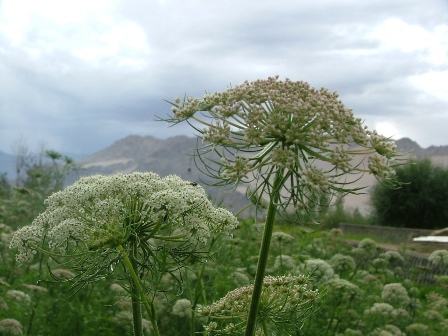
It is an annual or biennial herb growing up to a height of 50-70 cm with thick tuberous roots and glabrous stem, compound leaves with linear segments and small white flowers in umbels. The stem bears alternate, pinnate leaves with the upper leaves being smaller and less divided. The fruits are oblong, slightly curved, yellowish brown with prominent ribs. The plant grows wild in the temperate zone and is very common in meadows, shaded and moist places in the northwestern Himalayas at an altitude of 3200-4300 m. The reproductive cycle of the plant is from June-August/September.
|
| Medicinal uses: |
| Parts used: Fruit |
| Active principles: After crushing, the dried seeds yield 3-6% essential oils. High-grade carvone (45-66%) can be produced by fractonal distillation. Other constituents of the oil are lionene, a-pinene, b-pinene, terpinolene, myrecene, para-cymene, caryophyllene, trans-dihydrocarvone, cis-dihydrocarvone, cuminaldehyde, cis-perrilyl alcohol trans-carvone, cis-carvone, dihydrocarveol and cuminylalcohol. |
Disease cured and dosage:
- Ethnomedicinal: The people of Lahaul use powdered seeds for back pain and Spitians give powdered seeds (2 g) thrice a day for 3-4 days to cure body weakness. It is used as carminative, mild stomachic, lactagogue, febrifuge, tonic, stimulant, emmenogogue and anthelmintic and also for cold, cough, dyspepsia and hypertension. The people of Tawang use it with hot butter or fried in ghee and also put it on the head to relieve anxiety/hypertension (mostly after the death of near ones).
- Ethnoveterinary: A mixture of the seeds and buttermilk is prescribed for gastric problems in animals.
|
| Ayurveda/Unani prepration: Jirak-triya, churna. Prescribed dose: churna 3-6 g. |
Ayurvedic properties and actions:
- Guna (Qualities): Laghu (light), ruksha (dry)
- Rasa (taste): Katu (pungent)
- Vipaka (post digestive taste): Katu (pungent)
- Virya (potency): Ushna (hot)
|
Therapeutic description:
- Effect on humours: Alleviates vata, kapha. .
- Digestive system: Treats foul smelling of mouth, dyspepsia, vomiting, digestive upsets, flatulence and IBS (irritable bowel syndrome).
- Urino-genital system: Used during puerperal pathogenesis as it acts as a uterus purifier, galactogogue and appetizer.
- Temperature: Cures chronic fever and the associated complications (darun-moksha).
|
Drug preparation: To convert the plant into a drug, the fruits are powdered.
- The powder is yellow in colour with a strong aroma.
- An airtight moisture free container is used for storage.
- The shelf life of the powder is one year.
|
|
|
 |
|
| Family:
Apiaceae |
| Common name:
Shia-zira, Caraway |
| Local name: Shingujira (Lahaul), Shia-zira, Kala-jira (Joshimath), Gonyod (Spiti), Gonyod (Spiti), Go-nyo (Tawang), Siah-jeera (Hindi) |
| Ayurvedic name:
Krishna-jeerak |
|
|
|
| File Size:485.6015625kb |
|
|




