| Plant Profile: |
|
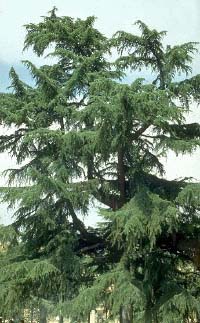
The name deodar means ‘wood of the gods’ and comes from the Sankrit language (dev = god + daru = wood). The tree is considered holy across northern india and its wood and needles are used in religious ceremonies. Cedrus deodara is a large evergreen coniferous tree with spreading branches and dark green foliage. The needles arise in tufts at the ends of short branchlets. The wood is aromatic, light and brown in colour. The male cones are cylindrical, about 5-12 cm long and erect. The female cones are ovoid or ovoid-cylindric and dark brown when ripe (October-November). It is distributed in most parts of Himachal Pradesh and Uttaranchal between 2200-2800 m elevations. Flowering and fruiting takes place in September-October. People collect the bark and wood from the wild.
|
| Medicinal uses: |
| Parts used: Wood and the oil |
| Active principles: Oleoresin and essential oil. The main component of the oil is sesquiterpene. |
Disease cured and dosage:
- Ethnomedicinal: A paste of the plant is applied to indolent swellings. The tar is used as an alterative and given in chronic diseases. It is also used in leprosy and applied on external ulcers. It is used in fever, flatulence, heart palpitations, pulmonary troubles, dropsy, paralysis, urinary disease, gonorrhoea, syphilis, rheumatism and gout. Vaids in Joshimath use its oil for curing rheumatism and skin diseases.
- Ethnoveterinary: Data not sufficient.
|
| Ayurveda/Unani prepration: Devdarvadi-kwath, Devdarvadi-churna, oil of devdar. Prescribed dose: churna 3-6 g, kwath 25-50 ml, taila 20-40 drops. |
Ayurvedic properties and actions:
- Guna (Qualities): Laghu (light), snigdha (slimy)
- Rasa (taste): Tikta (bitter)
- Vipaka (post digestive taste): Katu (pungent)
- Virya (potency): Ushna (hot)
|
Therapeutic description:
- Effect on humours: Alleviates vata, kapha.
- Systemic effects: Used to treat gout, inflammatory disorders, skin diseases, wounds and lacerations.
- Nervous system: Cures sciatica and headaches.
- Blood vascular system: Used in the treatment of cardiac debility, gout, other inflammatory disorders and other lymphatic disorders such as filariasis.
- Respiratory system: Cures catarrh, productive cough, hiccough, and dyspnoea.
- Digestive system: Treats flatulence, constipation and worms-infestation.
- Urino-genital system: It is also used to treat dysurea, pyourea, and diabetes insipidus, and puerperal diseases and acts as a galactopurifier.
- Temperature: Treats chronic fever.
|
Drug preparation: To convert the plant into a drug, the oil is extracted from the bark and stem.
- The drug is called diyar taila .
- It must be stored in a moisture free container.
- It can be externally used as a poultice, soft paste and lotion. It can also be ingestion or taken as enema.
|
|
|
 |
|
| Family:
Pinaceae |
| Common name:
Cedarwood |
| Local name: Devdaru, Devdar, Kewli, Kelon (Joshimath), Devdar (Hindi) |
| Ayurvedic name:
Devdaru, Bhadradaru, Surbhurah |
|
|
|
| File Size:370.697265625kb |
|
|




