| Plant Profile: |
| It is a large tree with smooth and thick bark, which is greenish white in colour and flaking off in large flat pieces. The leaves are usually sub opposite oblong or elliptic oblong and pale brown beneath. The flowers are sessile and borne in short, axillary spikes or in terminal panicles. The drupe is 2.5–5 cm long, ovoid or obovoid-oblong, fibrous, woody, glabrous and dark brown in colour with 5 hard projecting wings. The tree is found throughout India in the sub-Himalayan tract, Madhya Pradesh, Maharashtra and Tamil Nadu chiefly along water channels, stream banks and moist places. Flowering occurs in April-May and fruiting in the cold season. The tree prefers loose, moist fertile and alluvial loam. |
| Medicinal uses: |
| Parts used: Bark and fruits |
| Active principles: The bark contains a crystalline compound arjunin, a lactone arjunetine, essential oil, tannin, reducing sugars and colouring matter. It has so many minerals. |
Disease cured and dosage:
- Ethnomedicinal: A preparation from the bark and fruits is used as a tonic, astringent, febrifuge and deobstruent for treatment in bilious affections and for sores. T. arjuna is a reported cardiac tonic and is useful in blood dysentery, blood pressure, fracture of bone, heart diseases, leucorrhoea and earache and acts as antidote to poison.
- Ethnoveterinary: Data not sufficient
|
| Ayurveda/Unani prepration: Arjunarishta, kakubhadi churna, arjuna swarasa. Prescribed dose: swarasa 10-20 ml, arishta 50 ml, churna 3-6 g. |
Ayurvedic properties and actions:
- Guna (Qualities): Laghu(light),ruksha(dry)
- Rasa (taste): Kashay (astringent)
- Vipaka (post digestive taste): Katu (pungent)
- Virya (potency): Sheet (cold)
- Prabhav (effect): Hridya (cardiac)
As per Charaka Samhita it is considered as udardprashman (antiallergic) and kashay-skand (astringent taste).
|
Therapeutic description:
- Effect on humours: Alleviates pitta, kapha
- Systemic effects: Treats acute external bleeding (churna) and fracture of bone (bark).
- Respiratory system: It also treats tubercular cough and haemoptysis.
- Digestive system: It is used in the treatment of bleeding piles and bloody dysentery.
- Urino-genital system: Cures pyourea and burning micturition.
- Skin: Treats itching, allergic skin rashes.
- Temperature: Cures chronic fever.
|
Drug preparation: To convert the plant into a drug, the bark is peeled off and crushed and dried and crushed into a powder.
- The powder must be stored in damp free containers and has a shelf life of one year.
- The dosage is Arjuna-kheer pak (1 part Arjuna: 8 part milk: 32 part water)
|
|
|
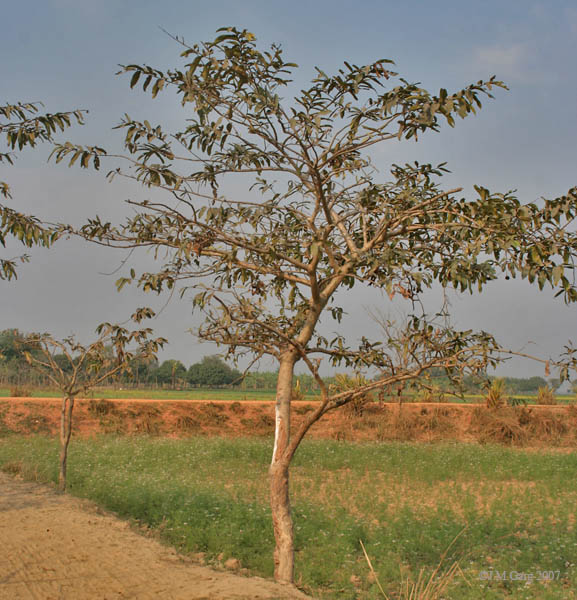 |
|
| Family:
Combretaceae |
| Common name:
Arjuna |
| Local name: Arjuna, Arjun, Arjan (Joshimath), Arjuna (Hindi) |
| Ayurvedic name:
Arjuna, Dhawal, Kakubh, Virvriksha |
|
|
|
| File Size:855.8193359375kb |
|
|




